 how-to
Why Your Moonshine Tastes Metallic: Causes & Fixes
Table of Contents
- Why Metallic Moonshine Happens: The Main Causes
- Metal Leaching from Still Materials
- Chemical Reactions During Distillation
- How to Spot Poor Soldering Before It Ruins Your Batch
- Cleaning Copper Stills: A Step-by-Step Protocol
- Troubleshooting Moonshine Off-Flavors: Diagnostic Steps
- Water Quality and Mineral Content in Your Mash
- Copper vs. Stainless Steel: Choosing the Right Vapor Path
- Frequently Asked Questions
Last Updated: September 27, 2026
Why Metallic Moonshine Happens: The Main Causes
If you're wondering why does my moonshine taste metallic, the answer usually comes down to two things: metal leaching from your still, or a chemical reaction inside the boiler.
Metal Leaching from Still Materials
Metal leaching is the transfer of metal ions from your still into the vapor or liquid during a run. It happens when the wrong metal meets heat, acid, or time:
- Copper: Traditional and reactive. It binds sulfur compounds and improves flavor when clean.
- Stainless steel: Stable and neutral. It won't add flavor, but it won't strip impurities either.
- Aluminum: A poor choice. It reacts with acidic vapors and can leave a sharp, metallic note.
- Lead-based solder: The worst offender. It can contaminate a batch and pose a real health risk.
Chemical Reactions During Distillation
Chemical reactions during distillation happen when heat and acid break down compounds in your wash. Two matter most. Oxidation occurs when copper or other metals react with oxygen and acids in the vapor, creating metallic salts that carry over into your spirit. Hydrolysis of lipids happens when fats in the wash break apart under heat, producing free fatty acids that react with metal surfaces.
How to Spot Poor Soldering Before It Ruins Your Batch
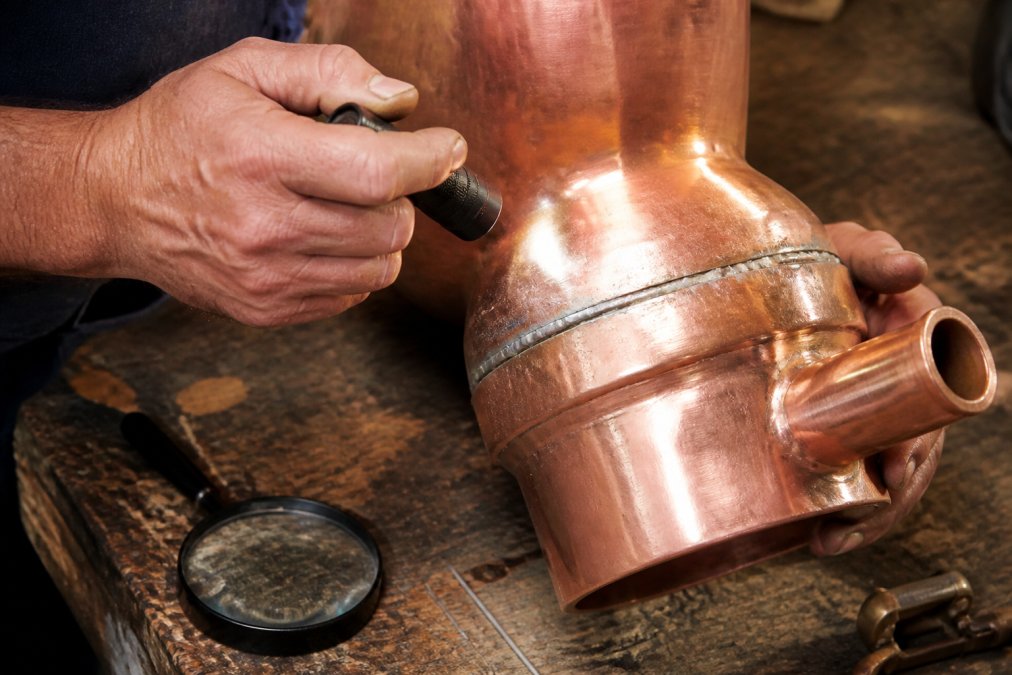
Learning how to spot poor soldering protects your batches: bad joints leak metal into the vapor path, and the damage shows up in every run.
Visual Inspection Checklist for Solder Joints
- Look for dull, gray, or chalky solder instead of a bright silver finish
- Check for cracks, pits, or gaps along the seam
- Look for solder that looks lumpy or uneven
- Check for green or white residue around the joint
- Run a finger along the seam to feel for rough spots
- Confirm the solder is labeled lead-free
- Shine a flashlight behind the joint to spot pinholes
If any box stays unchecked, stop and fix the joint before your next run.
Cleaning Copper Stills: A Step-by-Step Protocol
Cleaning copper stills correctly removes the tarnish and residue that cause metallic flavors. Skip it and even good copper turns your spirit harsh.
Total Time: About 45 minutes Difficulty: Beginner
What You'll Need
- White vinegar
- Coarse salt
- Soft cloth or sponge
- Warm water
- Clean towels
Step 1: Rinse the Still [Time: 5 minutes]
Flush the interior with warm water to remove loose residue.
Step 2: Mix Your Cleaning Paste [Time: 5 minutes]
Combine equal parts vinegar and salt into a paste.
Step 3: Scrub the Copper [Time: 15 minutes]
Apply the paste with a soft cloth. Work it into tarnished areas.
Step 4: Rinse Thoroughly [Time: 10 minutes]
Rinse with warm water until no paste remains.
Step 5: Dry Completely [Time: 10 minutes]
Dry every surface. Moisture speeds up tarnish.
Expected Result: Bright, pinkish copper with no dark spots or film.
The Sacrificial Run Method
A sacrificial run is a cleaning run you throw away: fill the still, run it, discard the output. It flushes out loose residue, flux, and metal particles left from manufacturing or cleaning. Never drink the output. Run one after any deep clean or new build, then a second if the output still smells sharp.
Troubleshooting Moonshine Off-Flavors: Diagnostic Steps
Troubleshooting moonshine off-flavors starts with one question: where in the run does the taste appear? Follow these steps:
- Taste the wash before distilling. A metallic note here points to water or ingredients.
- Taste the heads, hearts, and tails separately. Metal flavors in the heads often mean a dirty still.
- Check your still for tarnish or corrosion.
- Inspect every solder joint.
- Test your water source.
- Run a sacrificial run and taste again.
Testing for Heavy Metals at Home
Heavy metals are the hidden cause most home distillers never check. Lead, copper, and aluminum can all end up in a finished spirit, and none announce themselves by smell. Two kit categories help:
- Lead test swabs (the same chemistry used for testing paint and pottery) turn pink or red on contact with leachable lead. They cost a few dollars per swab at hardware stores. Swab the inside of a suspect solder joint, the boiler, and the condenser outlet.
- Multi-metal water-test strips sold for well-water testing screen for copper, iron, zinc, and manganese. Less sensitive than a lab test, but they flag a gross problem.
pH Balance and Metal Corrosion
An acidic wash doesn't just taste sharp, it actively dissolves metal from your still into the vapor path. Copper, aluminum, and lead all react with acids to form soluble salts, and the lower the pH, the faster the reaction. A wash at pH 3.5 pulls far more metal into solution than the same wash at pH 5.5 over an identical run time.
What to do with the number.
- Below 4.0: Dilute with clean water, add a small amount of calcium carbonate (chalk) or potassium bicarbonate, and re-check. Add in small increments, overshooting into the alkaline range creates its own off-flavors.
- 4.0-5.5: This is the working range. Metal pickup is slow and manageable.
- Above 6.0: Not a corrosion problem, but a stalled-fermentation and bacterial-risk problem. Bring it down with acid blend or a small amount of backset.
Log your wash pH next to your run notes. After three or four batches you will see the pattern: the runs that tasted metallic will line up with the lowest pH readings. That correlation is worth more than any single fix.
Water Quality and Mineral Content in Your Mash
Water quality and mineral content shape your final flavor more than most distillers realize. Your wash is mostly water, so what's in the water ends up in the bottle, and metallic off-flavors are one of water's clearest fingerprints.
Which Minerals Cause Which Off-Flavor
- Iron: The classic metallic culprit. Even a few parts per million leaves a bitter, coin-like note that survives distillation. Common in well water and water that has sat in old galvanized or cast-iron plumbing.
- Manganese: Adds an earthy, harsh edge that reads as metallic on the finish. Often shows up alongside iron in well water.
- Zinc: Sharp, astringent aftertaste. More common in water that has contacted galvanized fittings.
- Copper: Usually a still problem, not a water problem, but if your incoming water already carries copper from household plumbing, you are starting behind.
- High overall hardness (calcium and magnesium): Does not taste metallic on its own, but it amplifies every other off-flavor and can throw off mash pH.
How to Read Your Water Report
On a municipal supply, your utility publishes a free annual consumer confidence report online, listing detected levels for iron, manganese, copper, lead, and more. Look for anything flagged above the secondary maximum contaminant level, those are aesthetic standards, and iron and manganese are both on that list. On a well, no one tests for you; a basic well-water panel from a state-certified lab covers the metals that matter and typically costs less than a batch of ingredients.
Treatment Options, Ranked by Effort
1. Switch sources. The fastest fix. If your tap water tastes off, your spirit will too. Buying low-mineral bottled water for a single test batch is the cheapest diagnostic you can run, if the metallic note disappears, you have your answer.
A Practical Test Protocol
You don't need a lab to narrow this down. Run three small washes side by side with the same recipe and yeast:
- Batch A: your normal tap water
- Batch B: carbon-filtered tap water
- Batch C: RO or distilled water with yeast nutrient added
Copper vs. Stainless Steel: Choosing the Right Vapor Path
Copper and stainless steel each play a different role in your vapor path. The right choice depends on what you want from your spirit.
| Material | Flavor Impact | Best For | Watch Out For |
|---|---|---|---|
| Copper | Binds sulfur, improves flavor | Flavor-focused runs | Tarnish and leaching if dirty |
| Stainless steel | Neutral, no flavor added | Clean, neutral spirits | Won't strip impurities |
| Aluminum | Adds metallic notes | Not recommended | Reacts with acidic vapor |
Order Online 24/7
Frequently Asked Questions
Why does my alcohol taste like metal?
A metallic taste in moonshine usually comes from one of four sources: leaching from reactive still materials like aluminum or poor-quality solder, acidic wash pH below 4.0 dissolving metal ions, contaminated water with high iron or manganese, or oxidation creating aldehydes. Inspect your vapor path first. If you see green or white corrosion on copper, that is copper acetate forming from acid exposure. Clean it and check your wash pH before your next run.
How does poor soldering affect the flavor of moonshine?
Poor soldering creates two problems. First, if the solder contains lead or cadmium, acidic vapor can leach those metals into your distillate. Second, a cold solder joint or a pin-hole gap lets vapor escape and air enter, causing oxidation that produces metallic-tasting aldehydes. Look for dull, grainy, or lumpy solder instead of smooth shiny beads. Reflux stills with multiple joints need every seam fully sealed.
Is a metallic taste in moonshine a sign of a safety issue?
It can be. A metallic taste from copper or stainless steel is unpleasant but not dangerous. However, if your still uses aluminum, galvanized fittings, or lead-containing solder, the taste could indicate heavy metal contamination. Stop drinking that batch and use a heavy metals test kit on your distillate. Replace any aluminum or unknown-alloy components with 99.9% pure copper or food-grade stainless steel and lead-free silver solder.
How do I clean my copper still to prevent off-flavors?
Run a 50/50 water and white vinegar solution through your still, then follow with a sacrificial run of cheap alcohol that you discard. After each use, rinse with hot water and dry immediately. For heavy tarnish, make a paste of flour, salt, and vinegar, scrub the interior, and rinse thoroughly. Never use steel wool on copper. It scratches the surface and creates sites for oxidation and future corrosion.