 How-to
How Long Do Copper Stills Last and What Shortens Their Life
Last Updated: November 13, 2026
Quick Summary
A well-built copper still can last many years, and some owners pass them down, but the claim that copper stills last decades is not a guarantee. Real service life depends on wall thickness, solder quality, run count, and how you clean and store the still.
- Schedule inspections by run count, not the calendar: a still run weekly sees about 260 heat cycles in five years.
- Rinse with warm water, dry fully, and store dry after every run to prevent the most common durability problem.
- Never leave water sitting in the boiler between runs, and store the still with the lid off or loose.
- A joint that flexes when pressed gently is a fail even if it is not yet leaking.
- When two or more structural issues appear together, replacement is usually more economical than chasing repairs.
Table of Contents
- How Long Copper Stills Last and What the Decades Claim Really Means
- Lifespan by Use Intensity and Operating Environment
- Copper Still Maintenance: The Schedule That Adds Years
- How to Clean a Copper Still Without Damaging It
- Tarnish, Patina, and Discoloration: What Is Normal
- The Copper Still Leak Test and Inspection Checklist
- Copper Still Solder Joints: What Wear Looks Like and How to Fix It
- Copper Versus Stainless Steel Stills: Longevity Trade-Offs
- Frequently Asked Questions
How Long Copper Stills Last and What the Decades Claim Really Means
A well-built copper still can serve a careful distiller for many years, and some owners do pass them down. But the popular claim that a copper still "lasts decades" hides the real variables. A still lasts as long as the care behind it.
Copper still lifespan is the usable service life of a pot still before seams, joints, or the boiler itself need repair or replacement. That life depends on wall thickness, solder quality, how often you run it, and how you clean and store it.
The word "decades" is not a guarantee. It is an outcome of good construction plus good habits. Below, we break down what drives copper still longevity, how to inspect and maintain your equipment, and when repair beats replacement.
Lifespan by Use Intensity and Operating Environment
A weekend hobbyist and a small commercial distillery can own the same still and get very different service life from it. Frequency of use is the biggest divider, but it is not the only one.
Here is a practical way to think about it:
| Use Pattern | Runs Per Month | Typical Care Level | Expected Service Life |
|---|---|---|---|
| Weekend hobbyist | 1-4 | Rinse and dry after each run | Many years with light wear |
| Active hobbyist | 5-12 | Full cleaning plus monthly inspection | Long life if joints are checked |
| Small commercial | 15+ | Scheduled maintenance and logs | Shorter intervals between repairs |
Those ranges are guidance, not a warranty. A still's real service life is set by four interacting variables: wall thickness, solder quality, run count, and storage conditions.
Why run count matters more than calendar age. Each distillation run is a heat cycle. Copper expands when heated and contracts when cooled, and the seams and solder joints absorb that movement.
How the operating environment accelerates wear. Moisture is the quiet enemy. A still kept in a damp garage collects condensation on cold copper between runs, and that film drives tarnish and, over time, surface corrosion.
How cleaning habits compound or offset wear. Gentle cleaning with warm water and soft cloths removes residue without scratching. Harsh abrasives and strong acids pit the surface and thin the wall, and a pitted interior gives corrosion a place to start.
The takeaway is simple. Match your inspection schedule to your run count, not to the calendar alone, and treat storage and cleaning as part of the lifespan equation rather than as afterthoughts.
Copper Still Maintenance: The Schedule That Adds Years
Copper still maintenance is the routine set of cleaning, drying, and inspection tasks that keep a still working and safe. The schedule below outlines routine care that helps protect a still.
- After every run: Rinse with warm water, dry fully, and store dry.
- Weekly or every few runs: Check seams and joints for soft spots or discoloration.
- Monthly: Run a full leak test and inspect the vapor cone and lyne arm.
- Seasonally: Review your log for patterns in wear and plan any repairs.
A Simple Maintenance and Recordkeeping Log
Keep a paper or digital log. It turns vague worry into clear data.
- Date of each distillation run
- Heat source used and run duration
- Cleaning done (rinse, deep clean, or none)
- Any tarnish, darkening, or discoloration spotted
- Leak test result (pass or fail)
- Repairs made and by whom
A log is the single most useful tool for judging when a still is nearing the end of its service life. Patterns show up in writing that you would miss by memory.
How to Clean a Copper Still Without Damaging It
Clean a copper still with warm water and a soft cloth, and skip harsh abrasives that scratch the surface. Gentle cleaning protects the copper and keeps the inside ready for the next run. For a full walkthrough of the method, see our guide on how to clean a copper still without damaging it.
A few habits protect the metal:
- Use soft cloths or non-scratch pads, never steel wool.
- Avoid strong acids that pit the copper surface.
- Clean the condenser and lyne arm, not just the pot.
- Never leave water sitting inside the boiler.
Rinsing, Drying, and Storing Between Runs
Rinse with warm water right after a run, while residue is soft. Then dry every surface, including the inside of the condenser. Moisture left in a closed still is what drives tarnish and corrosion between sessions.
Store the still with the lid off or loose so air can move through it. Keep it away from damp floors and chemical fumes. A dry, ventilated spot adds years of service life for almost no effort.
Tarnish, Patina, and Discoloration: What Is Normal
Some color change on copper is normal and even expected. A thin, even patina is copper reacting to air and use. It is not damage. Darkening on the outside of the boiler is cosmetic.
What you should watch for is uneven or sudden change:
- Normal: even brown patina, slight darkening on the exterior.
- Watch closely: greenish spots, white powdery patches, or dark pitting.
- Act now: soft spots near seams or flaking around joints.
Green or white buildup can signal corrosion that needs attention. Clean it gently and inspect the area. If the metal feels thin or soft, treat it as a repair signal, not a cleaning problem.
The Copper Still Leak Test and Inspection Checklist
A copper still leak test is a simple pressure or soapy-water check that confirms vapor and liquid stay where they should. Run it before every season and after any repair.
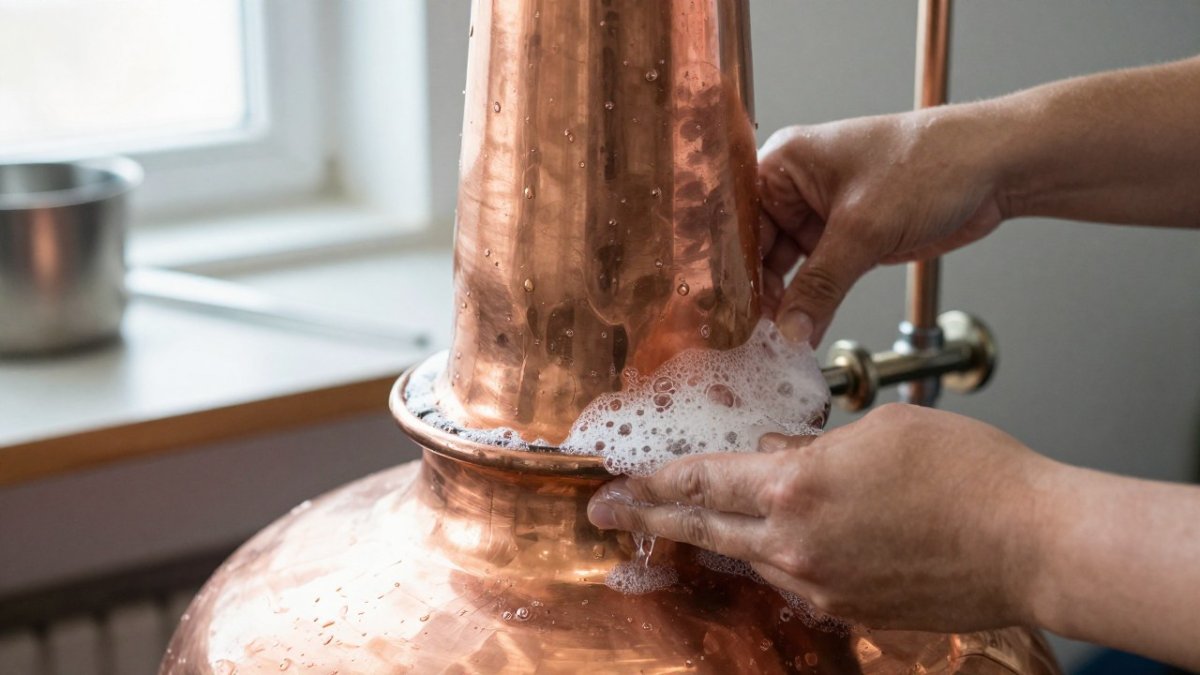
Use this pass/fail checklist:
- Seams: no bubbles when soapy water is applied under light pressure.
- Solder joints: no soft spots, cracks, or flaking.
- Lyne arm and vapor cone: no pinholes or thin spots.
- Condenser: no leaks at the water connections.
- Boiler base: no scorching or warping.
For the full procedure, read our step-by-step guide on how to test a still for leaks. A still that fails any line should come out of service until it is fixed.
How to read a borderline result. Not every mark means the same thing. A thin, even brown patina on the exterior is cosmetic and does not fail the checklist.
Repair versus replacement: a simple decision guide. Use the location and severity of the damage to decide, rather than the age of the still.
- Minor seam leak, sound metal around it: clean, re-flux, and re-solder with lead-free silver bearing solder. Repair.
- Crack at a seam edge with sound metal: patch or re-solder. Repair, then re-test.
- Soft or thin metal at a joint: a patch may not hold. Have a qualified repairer assess it; replacement of the affected section is often the better call.
- Pinholes in the lyne arm or vapor cone: repair if the surrounding metal is sound; replace the component if it is thin.
- Warped or scorched boiler base: if the warp is slight and the base still holds pressure, repair and change your heat method. If the base is thin or cracked, replace the boiler.
- Multiple failures at once: when two or more structural issues appear together, replacement is usually more economical than chasing repairs.
When to call a qualified repairer. Re-soldering a small seam leak is within reach of a careful owner.
A note on legal and safety boundaries. Distillation laws and safety requirements vary by location, and repairs that affect pressure containment or vapor paths should be treated as safety-critical.
Copper Still Solder Joints: What Wear Looks Like and How to Fix It
Solder joints are the most common failure point on any still, and they deserve a close look every month. Wear shows up as dull gray joints that turn chalky, cracks at the seam edge, or joints that flex when you press them gently.
Fix minor seam leaks by cleaning the area, re-fluxing, and re-soldering with lead-free silver bearing solder. Larger cracks or thin metal call for a patch or a professional repair. If your joints show wear, our guide on how to fix leaking still seams walks through the repair step by step.
Watch out: soldering over a dirty or wet joint hides the problem instead of fixing it. The leak returns, often mid-run.
Copper Versus Stainless Steel Stills: Longevity Trade-Offs
Copper and stainless steel fail in different ways, and that difference shapes longevity. Stainless resists rust and needs less polishing. Copper reacts with sulfur compounds during distillation, which is why distillers value it for spirit quality.
Here is the honest trade-off:
- Copper pros: reacts with sulfur compounds, supports flavor, repairable seams, proven in distillation for generations.
- Copper cons: tarnishes, needs regular cleaning, seams need inspection.
- Stainless pros: resists rust, low polishing, easy to wipe down.
- Stainless cons: no sulfur reaction, less flavor benefit, welded joints can be harder to repair.
For a deeper look at what makes a still durable, see our copper quality and durability guide. If you are weighing lifespan claims, our guide on whether your copper still is structurally sound helps you judge it.
Copper stills reward owners who inspect, clean, and log their runs. Steven StillZ LLC builds each still by hand from Paul Revere Copper with 99.9% pure 20oz copper and 100% lead-free silver bearing solder. Every unit undergoes water and air pressure testing. Our parts are rolled, hemmed, and beaded for structural integrity, and every still carries a 100% money-back or replacement guarantee. Order online 24/7 from Steven StillZ LLC.
Frequently Asked Questions
How long does a copper still last?
A well-built copper pot still can stay in service for many years with proper care. The copper itself does not wear out quickly; seams, solder joints, and fittings usually fail first. How long yours lasts depends on copper thickness, how often you run it, how you clean it, and whether you store it dry. A still run hard every week and stored damp will not reach the same age as one run monthly and dried properly.
What affects the lifespan of a copper still?
Four things matter most. First, copper thickness: 20oz copper holds up far better than thin sheet. Second, construction quality, especially rolled and beaded seams and properly flowed lead-free solder joints. Third, operating conditions, including heat source and how hot the boiler runs. Fourth, cleaning and storage habits. Leftover wash, acidic residues, and moisture sitting in the still between runs speed up corrosion at seams. Track these and you can predict wear before it becomes a leak.
Can a copper still develop leaks or corrosion?
Yes, and both usually start at joints rather than in the copper sheet itself. Corrosion appears as green or blue-green crust, pitting, or a chalky white deposit near a seam. Leaks show up as vapor escaping during a run or liquid seeping at the boiler base. Run a copper still leak test before each season by sealing the openings and applying low air pressure with soapy water on every joint. Bubbles mean a leak that needs repair before your next distillation run.
Is it safe to use a copper still with damaged solder joints?
No. A cracked or pitted solder joint can leak vapor, and vapor escaping near a burner is a fire risk. Have the joint repaired with lead-free silver bearing solder by someone who knows copper, or stop using the still. Never patch a joint with hardware-store plumbing solder of unknown composition, because lead contamination in the vapor path defeats the reason you bought copper in the first place. If the joint cannot be reflowed cleanly, replacement is the safer call.