 ultimate-guide
Best Copper Thickness for Stills: 2026 Ultimate Guide
Table of Contents
- Why Copper Thickness Decides Still Performance
- Copper Gauge vs Thickness Chart: Mil, Ounces, and Gauge Explained
- Best Copper Thickness for Stills: Boiler vs Column vs Dome
- How to Verify Copper Purity: C110 and 99.9% Copper Tests
- Lead-Free Silver Bearing Solder for Stills: What to Look For
- Thermal Conductivity vs Thickness: The Trade-Off Nobody Explains
- Repair and Maintenance of Thin-Gauge Copper Stills
- Legal and Safety Compliance for DIY Still Builds
- Frequently Asked Questions
Last Updated: September 27, 2026
Why Copper Thickness Decides Still Performance
The best copper thickness for stills sits between 20 and 22 gauge for boiler walls, with 20oz copper (roughly 0.032 inches) being the benchmark professional builders return to. That specification determines whether your still survives a decade of heat cycles or develops a seam leak in year two.
Copper Gauge vs Thickness Chart: Mil, Ounces, and Gauge Explained
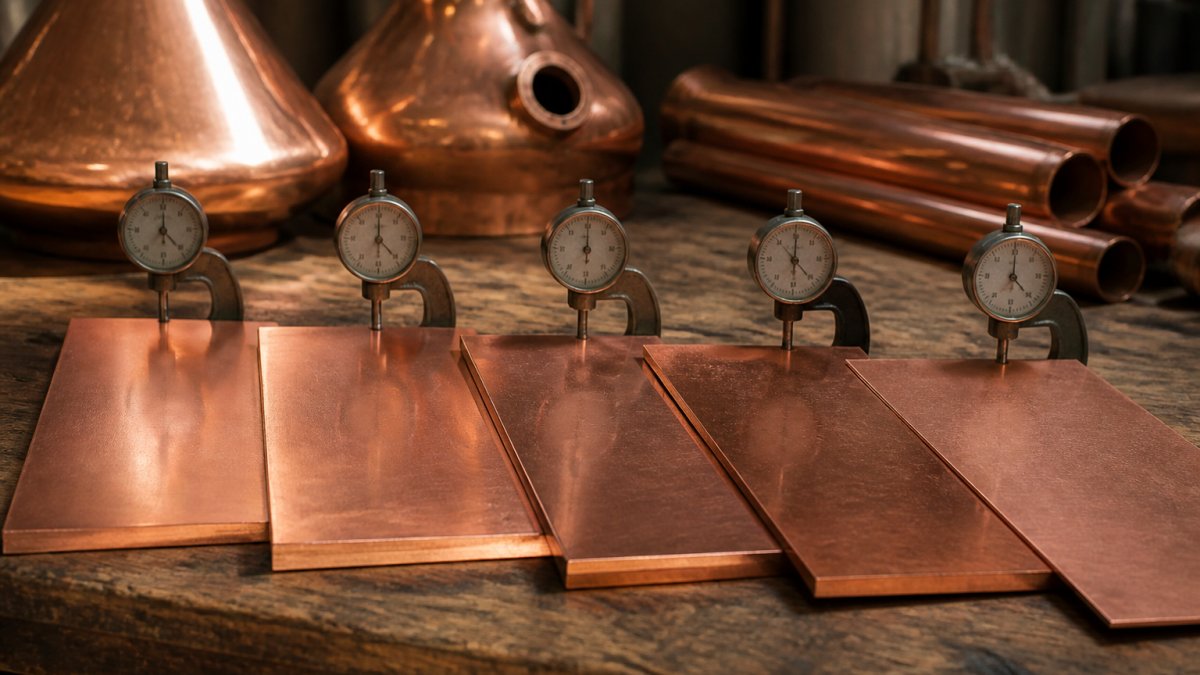
Copper thickness for stills is measured three ways that describe the same sheet: gauge number, mil thickness, and ounces per square foot. Confusion arises because a lower gauge number means a thicker sheet, while a higher ounce rating also means thicker metal. Add inches and millimeters, and the same 20oz sheet can be listed four different ways by four suppliers.
| Gauge | Mil Thickness | Inches | Millimeters | Ounces per Sq Ft | Typical Still Use |
|---|---|---|---|---|---|
| 26 gauge | 16 mil | 0.016 in | 0.41 mm | 9.6oz | Decorative trim, ornamental bands |
| 24 gauge | 20 mil | 0.020 in | 0.51 mm | 12oz | Decorative cones, light lyne arms |
| 22 gauge | 25 mil | 0.025 in | 0.64 mm | 16oz | Small column sections, lyne arms |
| 20 gauge | 32 mil | 0.032 in | 0.81 mm | 20oz | Boiler walls, domes, main columns |
| 18 gauge | 40 mil | 0.040 in | 1.02 mm | 24oz | Heavy commercial boilers |
| 16 gauge | 51 mil | 0.051 in | 1.29 mm | 32oz | Industrial pressure vessels |
How to Verify the Thickness You Received
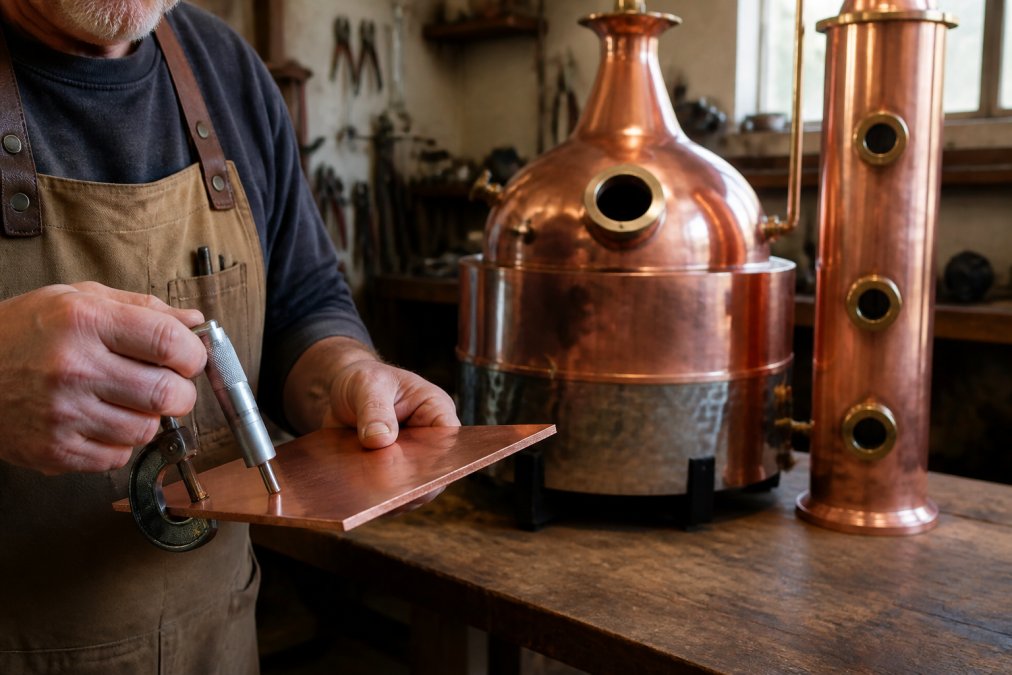
A caliper or micrometer is the only reliable check. Measure at three points, because rolling mills produce crown variation and a nominal 20-gauge sheet can arrive at 30 mil on one edge and 34 mil on the other. Without a micrometer, cut a 12-inch by 12-inch square, weigh it in ounces, and compare against the ounce column above: a true 20oz sheet weighs 20 ounces per square foot, while a mislabeled 16oz sheet weighs four ounces light.
When a supplier lists only "gauge," ask for the mil thickness in writing before you order. A written spec is your only recourse if the stock arrives undersized.
Why the Ounce Convention Exists
Copper sold by the ounce is a legacy of the roofing trade, where weight per square foot was the fastest way to estimate metal for a job. The convention carried into still building because the same suppliers stock both. It helps you read a catalog: an ounce-quoted listing is almost always roofing-grade C110, while a gauge-quoted listing is more likely a hardware-store sheet of unknown alloy.
Best Copper Thickness for Stills: Boiler vs Column vs Dome
The boiler, column, and dome each demand a different copper thickness because they face different stresses. Boilers resist pressure and deformation; columns carry vapor and need workability; domes need rigidity to hold a spun shape without oil-canning. The thickness that works for one will fail for another.
Boiler Walls: Why 20oz Copper Holds Up
A 20oz copper boiler wall is the practical minimum for a still in regular use. At 32 mil, the sheet resists the outward pressure of a rolling boil and the inward pull of cooling without flexing at the seams. Copper expands roughly 9.4 millionths of an inch per inch per degree Fahrenheit, so a 12-inch boiler wall heated from 70°F to 210°F grows about 0.016 inches each direction.
Column and Lyne Arm: Balancing Weight and Workability
Columns and lyne arms work well at 20 to 22 gauge. They need enough rigidity to hold shape but enough malleability to bend, flare, and fit without cracking. A 22-gauge column is lighter and easier to shape by hand; 20-gauge holds a cleaner form on taller columns that could sway.
Domes and Caps: Where Rigidity Beats Weight
A dome or onion cap is a spun or hammered shape, and forming work-hardens the copper. Work-hardened copper is stronger but less ductile, so a dome too thin cracks at the shoulder during forming, while one too thick will not take the shape. Most builders land on 20-gauge: thick enough to hold a spun curve without oil-canning, thin enough to anneal and re-form if a hammer mark needs correction.
If you run a thick 20oz boiler on a modest burner, pre-heat gradually. Slamming full flame onto cold thick copper creates uneven expansion across the seam and stresses the joint before the metal has warmed through.
Matching Thickness to Heat Source
A 20oz boiler on a 50,000 BTU propane burner reaches a rolling boil in roughly 25 to 35 minutes for a 5-gallon charge; on a 30,000 BTU burner it takes 45 minutes or more, because the extra copper mass must be saturated first. A 24-gauge boiler on that same 30,000 BTU burner hits boil in about 30 minutes but swings several degrees between flame adjustments.
How to Verify Copper Purity: C110 and 99.9% Copper Tests
C110 copper is the standard designation for electrolytic-tough-pitch copper with a minimum conductivity of 101% IACS and 99.9% purity, and it is the grade you want in a food-grade still. Purity matters because trace lead or alloying metals can leach into vapor contact surfaces over time.
Verifying what you actually received takes three checks:
- Ask for the mill certification. Reputable suppliers provide a material cert listing the alloy, temper, and thickness.
- Check the color and patina. Pure copper oxidizes to a uniform brown-black; alloys with significant zinc or nickel shift toward yellow.
- Confirm the solder. A 99.9% copper build means nothing if the joints are sealed with leaded solder.
Lead-Free Silver Bearing Solder for Stills: What to Look For
Lead-free silver bearing solder for stills is a tin-based alloy with a small percentage of silver and a melting range well above the temperatures a boiler wall reaches. The silver improves joint strength and wetting, which matters on vertical seams where gravity fights the solder.
What to check on the label:
- Tin content above 94%. Higher tin means a cleaner, stronger joint.
- Silver content between 2% and 6%. This is the working range for structural still joints.
- No lead, no cadmium. Both are prohibited in food-contact distillation equipment.
- A stated melting range. You want a solder that flows well below the temperature at which copper anneals and loses strength.
Thermal Conductivity vs Thickness: The Trade-Off Nobody Explains
Copper's thermal conductivity is fixed by purity, not thickness. A 20oz sheet and a 24-gauge sheet of the same C110 copper conduct heat at the same rate. Thickness changes how quickly the whole mass reaches temperature, not how well the metal moves heat.
If you run a thick 20oz boiler on a modest burner, pre-heat gradually. Slamming full flame onto cold thick copper creates uneven expansion across the seam and stresses the joint before the metal has warmed through.
Repair and Maintenance of Thin-Gauge Copper Stills
Thin-gauge copper fails at the seams first, not the sheet. The metal flexes with every heat cycle and the solder line eventually cracks. Repair means cleaning the joint back to bare copper, re-fitting the seam, and re-soldering with lead-free silver bearing solder.
- Drain and dry after every run. Standing liquid accelerates corrosion at the seam.
- Inspect seams with a bright light before each session. Cracks start small.
- Re-tin worn joints rather than patching over them. A patch hides the failure.
- Avoid harsh acids on the interior. They strip the protective oxide layer.
Legal and Safety Compliance for DIY Still Builds
Distillation rules in the United States sit with federal and state authorities and vary by state and by what you intend to produce. Operating without the required permits can carry serious penalties, so confirm local requirements before you build.
Frequently Asked Questions
What is the ideal copper thickness for a professional-grade still?
For a professional-grade still, the boiler walls should be at least 20oz (approximately 0.68mm) copper, while the column can be 18-20oz for a balance of durability and workability. Many high-end stills use 20oz Paul Revere copper for its structural rigidity and heat distribution. Thinner gauges, like 22-gauge (16oz), are common in hobby stills but may dent or warp under frequent use.
How does copper gauge affect the structural integrity of a still?
Copper gauge directly impacts how well a still resists dents, warping, and seam failure. Thicker copper (lower gauge number) provides greater tensile strength and rigidity, which is critical for pressure vessels and areas subject to thermal cycling. A 20oz copper boiler, for example, holds its shape better than a 16oz one, reducing the risk of leaks and extending the still's lifespan.
Why is 99.9% pure copper preferred for moonshine stills?
99.9% pure copper, such as C110, offers superior thermal conductivity and corrosion resistance compared to alloys. It also reacts with sulfur compounds in the distillate, removing off-flavors and producing a cleaner spirit. Impurities in lower-grade copper can leach into the product, affecting taste and safety. Always verify purity with a mill test report.
Does copper thickness impact heat distribution during distillation?
Yes, thicker copper spreads heat more evenly across the boiler surface, reducing hot spots that can scorch wash and create off-flavors. However, very thick copper takes longer to heat up. The sweet spot for most stills is 20oz (0.68mm) to 1.1mm, which provides even heat distribution without excessive preheating time.
What are the safety risks of using thin copper for stills?
Thin copper (e.g., 10 mil or 30-gauge) can dent, crack, or fail at seams under pressure, leading to leaks of hot, flammable vapor. It also warps easily when heated, compromising the seal. For safety, use copper that is at least 18oz (0.57mm) for boiler walls and ensure all joints are lead-free soldered and pressure-tested.
How can I verify the copper purity of a still before buying?
Ask the manufacturer for a mill test report (MTR) that certifies the copper grade, such as C110. Reputable sellers like StillZ provide documentation and use 99.9% pure copper.
Is 20oz copper better than 16oz for a moonshine still?
20oz copper is thicker and more durable than 16oz, making it better for stills that see frequent use or high heat. It resists dents and warping, and holds seams more securely. However, 16oz is lighter and easier to shape, which can be suitable for small hobby stills if handled carefully. For longevity and safety, 20oz is the preferred choice.
What type of solder should I use for a copper still?
Use lead-free silver bearing solder, which typically contains 4-6% silver and is safe for potable alcohol contact. Avoid lead-based solders, as lead can leach into the distillate. Ensure the solder is labeled lead-free and complies with FDA food-contact standards. StillZ uses 100% lead-free silver bearing solder in all their stills.