 Ultimate guide
Professional Copper Still Construction Standards
Last Updated: November 17, 2026
Quick Summary
Professional copper still construction standards require 99.9% pure copper, 20oz sheet, lead-free silver bearing solder, and both water and air pressure testing before a still is safe to heat, seal, and run. Every unit should be built to these documented material, joint, and testing requirements.
- Ask any supplier for the alloy grade and sheet weight in writing before ordering.
- Specify silver bearing lead-free solder and require the alloy designation on the invoice or build sheet.
- Test the whole assembly, including condenser and column joints, not just the boiler.
- Many production builds use copper in the vapor path and stainless for structural parts.
- Have a qualified engineer review the design against applicable codes before fabrication.
Table of Contents
- What Professional Copper Still Construction Standards Actually Require
- Copper Still Materials and Thickness: Grade, Purity, and Gauge
- Lead-Free Solder for Copper Stills: What to Specify and Verify
- Copper Still Leak Testing: Water, Air Pressure, and Inspection Records
- Copper vs. Stainless Steel Still: Performance, Durability, and Cost
- Tools, Safety Equipment, and Workshop Preparation
- Regulatory Requirements and Engineering Review Before You Build
- Ordering a Still That Meets These Standards
- Frequently Asked Questions
What Professional Copper Still Construction Standards Actually Require
Professional copper still construction standards are the documented material, joint, and testing requirements a still must meet before it is safe to heat, seal, and run. At Steven StillZ LLC, we build to specifications that include 99.9% pure copper, 20oz sheet, lead-free silver bearing solder, and water and air pressure testing.
Below, we break down grade and gauge, solder specification, leak testing, copper versus stainless performance, workshop safety, and the engineering review a serious build needs before any metal is cut.
Copper Still Materials and Thickness: Grade, Purity, and Gauge
The material decision is the whole build. A copper still is only as good as its alloy grade, its purity, and its sheet thickness, and all three get quietly downgraded on budget equipment.
Copper purity matters because trace alloying elements change how copper behaves under repeated heating and contact with vapor. Thickness matters just as much: 20oz sheet resists denting, holds shape through thermal cycling, and gives a joint enough edge to solder properly. Thinner sheet saves the maker money and costs you durability.
Why C110 Copper and 20oz Sheet Matter
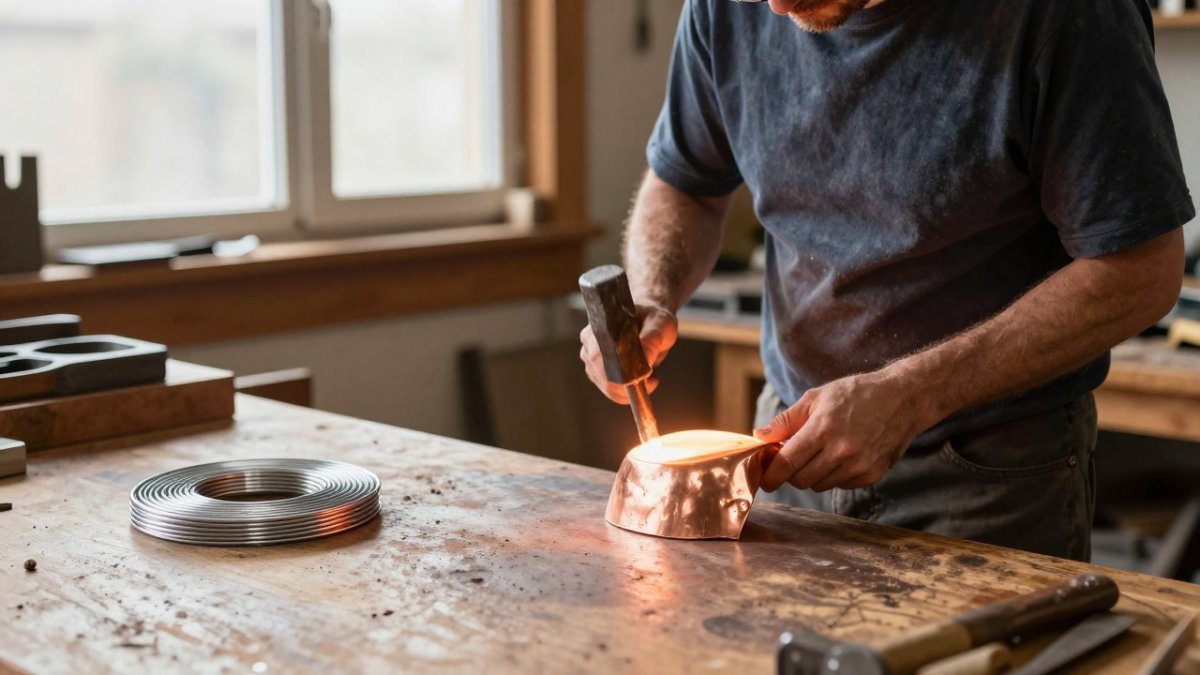
Our stills use Paul Revere Copper, machine-cut to 20oz, with parts rolled, hemmed, and beaded for structural integrity.
Ask any supplier for the alloy grade and the sheet weight in writing. If they cannot name both, you are guessing. For a deeper look at why gauge drives performance, see the benefits of heavy gauge copper in distillation equipment, and if you want to check a supplier's claims yourself, these seven copper purity tests show you how.
Lead-Free Solder for Copper Stills: What to Specify and Verify
Lead-free solder is not a marketing adjective; it is a specification you can name, request, and inspect. For copper stills, specify silver bearing lead-free solder and require the alloy designation on the invoice or build sheet.
Why lead-free? Because solder sits directly in the vapor path. Any lead in that joint is lead in your product, and no amount of cleaning removes it.
Verification is the part buyers skip. Ask three questions: what alloy, what documentation, and can I see the joint? A maker who cannot answer all three is not building to a standard. For a practical walkthrough on identifying compliant solder, read how to identify food safe solder for distilling.
Copper Still Leak Testing: Water, Air Pressure, and Inspection Records
Every unit we build goes through both water and air pressure testing before it ships.
A common mistake is testing only the boiler and skipping the condenser and column joints, which see their own stress. Test the whole assembly. For the full method, follow this step-by-step still leak testing guide.
Copper vs. Stainless Steel Still: Performance, Durability, and Cost
That trade-off is the entire decision, and most buyers pick based on price alone. The useful question is not which metal is better in the abstract but which metal belongs in which part of the still.
| Factor | Copper Still | Stainless Steel Still |
|---|---|---|
| Vapor contact | Reactive, binds sulfur compounds | Inert, no reaction |
| Flavor impact | Smoother, cleaner spirit | Neutral, less correction |
| Durability | Dents, patinas, needs care | Resists dents, easy to clean |
| Thermal conductivity | High, even heat spread | Lower, hot spots possible |
| Setup cost | Higher | Lower |
| Maintenance | Periodic cleaning, patina management | Simple wipe-down |
What Copper Actually Does in the Vapor Path
Copper's reactivity is not a flaw. It is the reason distillers have used it for generations. Stainless is inert: it does not react with sulfur compounds, so it does not remove them. If flavor correction is the goal, copper contact matters more than the spec sheet suggests.
The mechanism has a practical limit. Copper's sulfur-binding capacity is finite per run, which is why the metal darkens and needs cleaning between batches. A still with a copper boiler but a stainless column gets copper contact only in the boiler; a still with copper in the column and condenser gets it where the vapor is coolest and the sulfur compounds are most concentrated. That is why many production designs use copper for the vapor path and stainless for structural or non-contact parts.
Where Stainless Genuinely Wins
First, structural parts that see mechanical stress but no vapor contact, such as support frames and clamps, last longer in stainless because they do not dent or work-harden the way copper does. Second, cleaning: stainless tolerates stronger caustic cleaning agents than copper, which reacts to many of them. Third, upfront cost: stainless sheet is cheaper per square foot at equivalent thickness, which is why budget stills use it throughout.
The trade-off is thermal. Copper conducts heat roughly an order of magnitude better than stainless, so a copper boiler spreads heat evenly across its base and reduces hot spots that scorch wash. A stainless boiler concentrates heat at the burner contact point, which is why stainless stills often need a diffuser plate or a thicker base.
The Hybrid Configuration Most Production Builds Use
The common professional pattern is a hybrid: copper where vapor touches metal, stainless where structure and cost matter. A copper column and copper condenser with a stainless boiler shell and stainless fittings is a legitimate configuration, provided the vapor path from boiler to condenser is copper or is documented as intentionally stainless. What is not legitimate is marketing a still as "copper" when only the decorative exterior is copper and the vapor path is stainless. Ask which internal surfaces the vapor contacts before you accept a copper claim.
Watch out: a still described as "copper" may have a copper exterior shell over a stainless liner, which gives you the look and none of the vapor contact. Ask for the internal wetted-surface material in writing.
Tools, Safety Equipment, and Workshop Preparation
Workshop preparation is where serious builds are won, and it starts with the right tools and the right protective gear before any copper is cut. You need a solid bench, sheet metal shears or a nibbler, forming tools, a torch rated for the joint size, and clamps that hold a seam square while it cools.
Safety equipment is not optional. Safety goggles for cutting and forming, protective gloves for sharp sheet edges, a respirator or VOC mask for flux fumes, and forced ventilation for any soldering indoors. Keep a fire extinguisher within reach and never solder near solvent containers.
Regulatory Requirements and Engineering Review Before You Build
A still is a sealed vessel that holds heated liquid and vapor. Treat it like one, and the compliance questions sort into four buckets: the vessel itself, the heat source, the workplace, and the product.
The Vessel: Pressure, Materials, and Codes
A still boiler is a pressure vessel in the plain-language sense even when it runs at low pressure, because it is sealed, heated, and capable of building pressure if a condenser or vent plugs. For commercial or institutional installations, consider having a qualified engineer review the design against applicable codes before fabrication. The review should confirm the design pressure and vacuum rating, the relief device sizing, the material specification for every wetted surface, and the joint design for the expected thermal cycling.
Document material traceability as part of that review: alloy grade, sheet weight, solder alloy, and mill certificates where the supplier provides them. Those documents are what an inspector, insurer, or buyer's engineer will ask for, and they are the difference between a build that can be commissioned and one that cannot.
The Heat Source: Fire and Electrical Requirements
Open flame, electric elements, and steam each carry their own requirements. Open-flame heat sources raise fire and clearance questions that local fire codes address, including separation from combustibles and ventilation of the heat enclosure. Electric elements bring electrical code questions: circuit sizing, grounding, disconnects, and protection from washdown moisture. Steam brings boiler and pressure-relief requirements of its own. None of these are optional details; they determine whether an installation can be permitted at all.
The Workplace: Ventilation, Egress, and Emergency Planning
Workplace safety requirements apply to any commercial or educational installation. Plan ventilation for both solvent and vapor exposure, provide emergency shutdown for the heat source, keep fire extinguishers rated for the fuels present within reach, and document the emergency procedure. Burn hazards from exposed copper and hot condensate deserve the same planning as the flame itself. Independent testing and commissioning records close the loop: a documented commissioning run confirms the relief device works, the ventilation moves air, and the shutdown actually stops the heat.
The Product: Distilling and Equipment Rules
Distilling and distillation-equipment rules vary by jurisdiction and by whether the operation is personal, commercial, or educational. Equipment sold for distilling can carry its own requirements separate from the rules that govern the operator. Before you buy or build, confirm which rules apply to your use, your location, and your scale, and get the answer in writing from the authority that enforces them rather than from a supplier's marketing page.
Skipping this stage is how a hobby build becomes a liability. The engineering review, the traceability file, and the commissioning record are not paperwork for its own sake; they are what let a still be insured, inspected, and operated without surprises.
Ordering a Still That Meets These Standards
Ask for the alloy grade, the sheet weight, and the solder alloy before you order.
At Steven StillZ LLC, we build stills by hand from Paul Revere Copper, machine-cut to 20oz and 99.9% pure, joined with 100% lead-free silver bearing solder, with parts rolled, hemmed, and beaded for structural integrity. Each unit is water and air pressure tested, and we offer a 100% money-back or replacement guarantee.
Browse the stills that meet these standards in our shop.
The gap between a still that runs and a still you trust comes down to documented material, verified solder, and a pressure test you can point to. We build to those standards on every unit, and we stand behind them with a money-back or replacement guarantee. Get started with Steven StillZ LLC and order a still built from 99.9% pure copper, joined with lead-free silver bearing solder, and pressure tested before it ships.
Frequently Asked Questions
What copper thickness is appropriate for a commercial copper still?
Our stills are built with 20oz copper sheet. Thinner sheet, common on budget stills, dents easily and distorts under heat cycling, which stresses solder joints over time. Thicker sheet holds shape, transfers heat more evenly, and gives seams enough material to hem and bead properly. Ask the builder what gauge they use and whether the sheet is machine-cut for consistent dimensions.
What solder is safe for copper still construction?
Lead-free silver bearing solder is the standard for any still that contacts distillate or vapor. Lead-based solder has no place in distillation equipment because vapor and condensate contact the joint directly. Ask for the alloy specification and confirm the lead content is stated as zero, not just described as lead-free.
How should a copper still be tested for leaks?
Two tests matter: a water test to check the boiler and all liquid-side seams, and an air pressure test to catch vapor leaks in the column, condenser, and fittings. Our units are water and air pressure tested before they ship.
Is a professional-grade copper still overkill for a hobbyist?
It depends on how often you run and what you expect from the equipment. A hobbyist running a few batches a month will still notice the difference in heat response, joint durability, and the absence of metallic off-flavors that come from reactive or poorly cleaned materials.
How can I verify the copper and solder a builder claims to use?
Ask which copper and solder are used and whether the still undergoes water and pressure testing. If a builder cannot answer basic material questions, that tells you something about the rest of the build.