how-to
How to Verify Copper Purity: 7 Tests That Actually Work
Table of Contents
- Why Copper Purity Matters for Stills and Spirits
- What You'll Need Before You Start Testing
- Visual Inspection: Color, Luster, and Surface Finish
- The Magnet Test and Other Simple Copper Purity Testing Methods
- Acid Testing and Conductivity Measurement at Home
- Identifying Lead-Free Copper and Spotting Fakes
- Why Use 99.9% Pure Copper for Stills
- Professional Verification: Spectrometer and Eddy Current Testing
- Frequently Asked Questions
Last Updated: September 11, 2026
Why Copper Purity Matters for Stills and Spirits
Copper purity is the percentage of pure copper in a metal component by total mass. In a still, it decides how well the metal conducts heat, how it binds sulfur compounds, and whether anything unwanted leaches into your distillate. This guide from Steven StillZ LLC covers seven tests, from a magnet on your workbench to a lab spectrometer.
No single home test gives you a purity percentage. Each method narrows the possibilities; stacked together they get you close, and professional verification closes the gap for anything you'll trust with a batch of spirits.
Copper does real chemical work in a still: it reacts with sulfur compounds from fermentation and holds them back from the finished spirit, which is why traditional pot stills are built from it. Brass or copper-plated steel won't do that job.
What You'll Need Before You Start Testing
Gather your tools first: a kitchen scale accurate to 0.1 grams, a graduated cylinder or overflow container, a strong neodymium magnet, a jeweler's loupe, a clean white cloth, and for acid testing a diluted acid solution and gloves.
Calibration is the step everyone skips. A scale that reads 5 grams heavy throws off your density math and makes good copper look suspect, so weigh a known reference object first. Check your graduated cylinder's markings against a measured volume of water too.
- Kitchen scale accurate to 0.1 g, calibrated against a known mass
- Graduated cylinder or overflow container for water displacement
- Neodymium magnet
- Jeweler's loupe or 10x magnifier
- Diluted acid solution and nitrile gloves
- Clean white cloth or unglazed ceramic tile for the streak test
- Manufacturer documentation and material certifications
Visual Inspection: Color, Luster, and Surface Finish
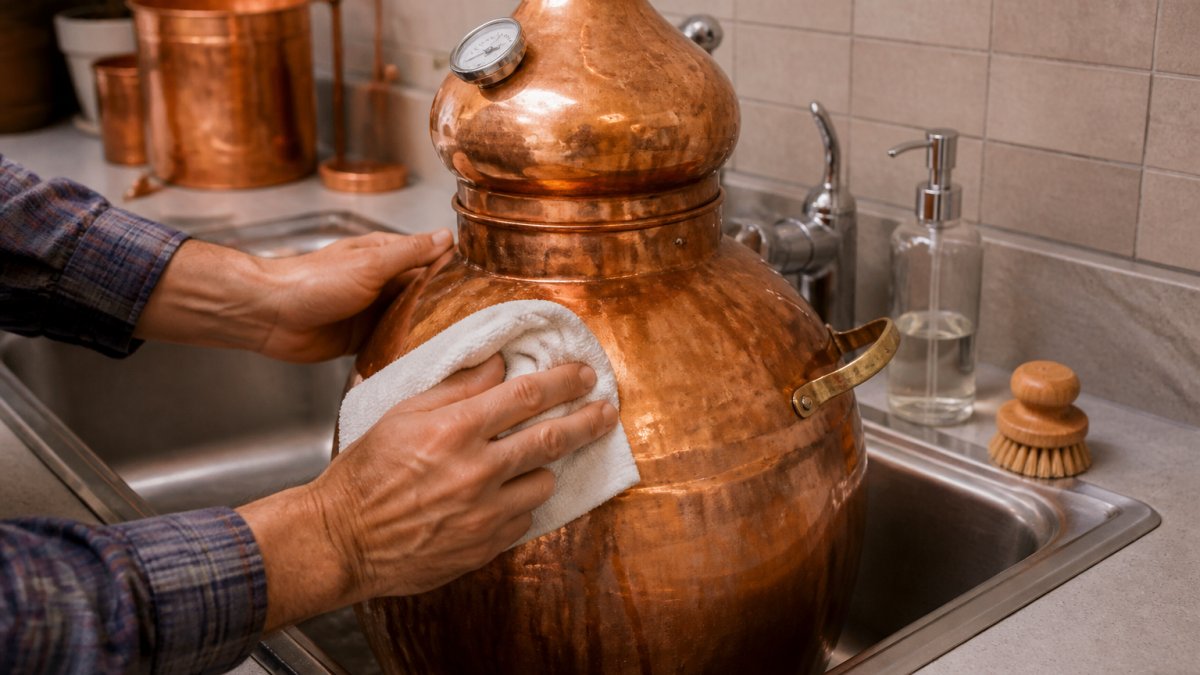
Real copper has a distinctive reddish-orange color that darkens to brown as it oxidizes; the greenish film on old copper is patina, a natural copper carbonate layer. Freshly cut copper should look bright and warm, not yellow, not gray, and not uniformly perfect.
Surface finish tells you a lot. Hand-made copper shows subtle tool marks, rolled edges, and slight tone variations, while electroplated imitations look too even, with base metal peeking through at seams, threads, and edges.
Look closely at those stress areas with your loupe. If the color changes near a joint or a threaded fitting, you're probably looking at plating over steel or zinc alloy. A magnet will confirm it in the next section.
The Magnet Test and Other Simple Copper Purity Testing Methods
The magnet test is the fastest screen: pure copper is diamagnetic, so it does not attract a magnet. If the magnet sticks, you're holding steel or iron. If it falls away, you've ruled out ferrous metals but confirmed nothing else.
Magnet Test: What It Reveals and What It Doesn't
The magnet test misses everything non-ferrous: brass, bronze, aluminum, and zinc alloys all pass it, as does copper-plated steel if the plating is thick enough. Treat a pass as a green light to keep testing, never as proof.
Weight, Density, and the Specific Gravity Check
Copper's density is roughly 8.9 grams per cubic centimeter (pubchem.ncbi.nlm.nih.gov). Weigh your component, measure its volume by water displacement, and divide mass by volume. A reading near 8.9 points to copper; brass lands closer to 8.5, and zinc alloys run lower still.
The catch is measurement error: a small component in a wide cylinder gives an imprecise volume reading. Use the narrowest cylinder that fits the part and repeat the measurement three times.
| Test | What It Rules Out | What It Can't Confirm |
|---|---|---|
| Visual inspection | Obvious plating, wrong color | Alloy composition |
| Magnet test | Steel and iron | Any non-ferrous metal |
| Density check | Low-density alloys | Copper vs. brass |
| Acid test | Non-reactive base metals | Purity percentage |
| Conductivity meter | High-resistance alloys | Trace elements |
Acid Testing and Conductivity Measurement at Home
Acid testing works on a simple principle: a drop of diluted nitric or hydrochloric acid on clean copper fizzes slightly and turns the solution blue-green. Brass reacts similarly, which is the limitation, the test confirms copper is present, not that it's pure.
Conductivity measurement is more discriminating. Copper is one of the best electrical conductors among common metals, and purity drives conductivity directly, since trace elements interrupt the crystal lattice and reduce it. A handheld conductivity meter gives a relative reading in seconds.
Conductivity readings only mean something against a known reference. Measure verified pure copper first, then your component: close numbers mean you're in good shape, and a noticeably lower reading means something is alloyed in.
Identifying Lead-Free Copper and Spotting Fakes
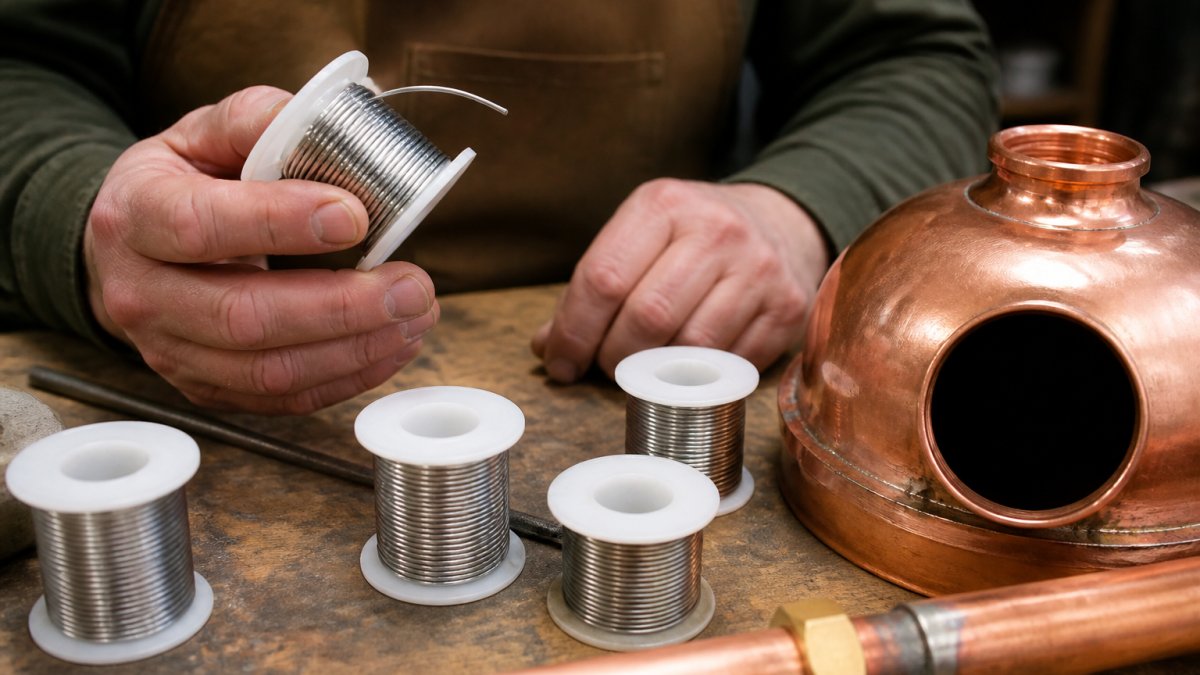
Lead contamination usually comes from solder, not the copper itself. Lead-free copper means the base metal is free of lead and the joints use lead-free solder, typically a silver-bearing alloy rather than the old tin-lead mix. You can't detect lead by eye, so documentation matters as much as testing.

A Spot-the-Fake Walkthrough
Most misidentified copper falls into four families. Run each suspect through this sequence before you trust it in a vapor path.
Copper-plated steel. The tell is weight and magnetism together. Steel is roughly 7.85 g/cm³ versus copper's 8.9 g/cm³, so a plated part feels lighter than its bulk suggests, and a strong magnet sticks to bare steel. Scratch a hidden edge with a file, gray under the copper color means plating.
Brass sold as copper. Brass is copper alloyed with zinc, usually 60-70% copper for common yellow brass (copper.org). It passes the magnet test and fizzes under acid much like copper. The giveaways are color (yellow rather than red-orange), density (about 8.4-8.7 g/cm³), and conductivity (roughly 28% IACS versus copper's 100% IACS). A conductivity meter separates brass from copper faster than any acid drop.
Bronze sold as copper. Bronze is copper plus tin, sometimes with other elements. It's harder, rings differently when tapped, reads lower on conductivity, and skews brown or gold rather than red-orange.
Copper with filled or contaminated joints. This fake passes every surface test. Under magnification, a proper lead-free silver-bearing solder joint is smooth, bright, and consistent, while filled joints show pitting, discoloration, or a dull gray line. If the joint color doesn't match the surrounding copper, ask what alloy was used.
Reading Material Certifications
A mill test report (MTR) actually proves what you bought. It lists the alloy by UNS number, C11000 for electrolytic tough pitch copper, C12200 for phosphorus deoxidized copper, plus chemical composition and mechanical properties. Ask for the MTR, not a marketing sheet; if a supplier can't produce one, treat the claim as unverified.
For solder, ask for the alloy composition by percentage. Lead-free silver-bearing solders commonly run 94-96% tin with a few percent silver and copper. Anything described only as 'lead-free' without a breakdown is a claim, not a certification.
A Quick Field Checklist
- Weigh the part and compare to expected mass for its volume
- Test with a strong neodymium magnet
- Scratch a hidden edge and check the color under the surface
- Check conductivity against a known copper reference
- Inspect all joints under 10x magnification
- Request the mill test report and solder composition sheet
Why Use 99.9% Pure Copper for Stills
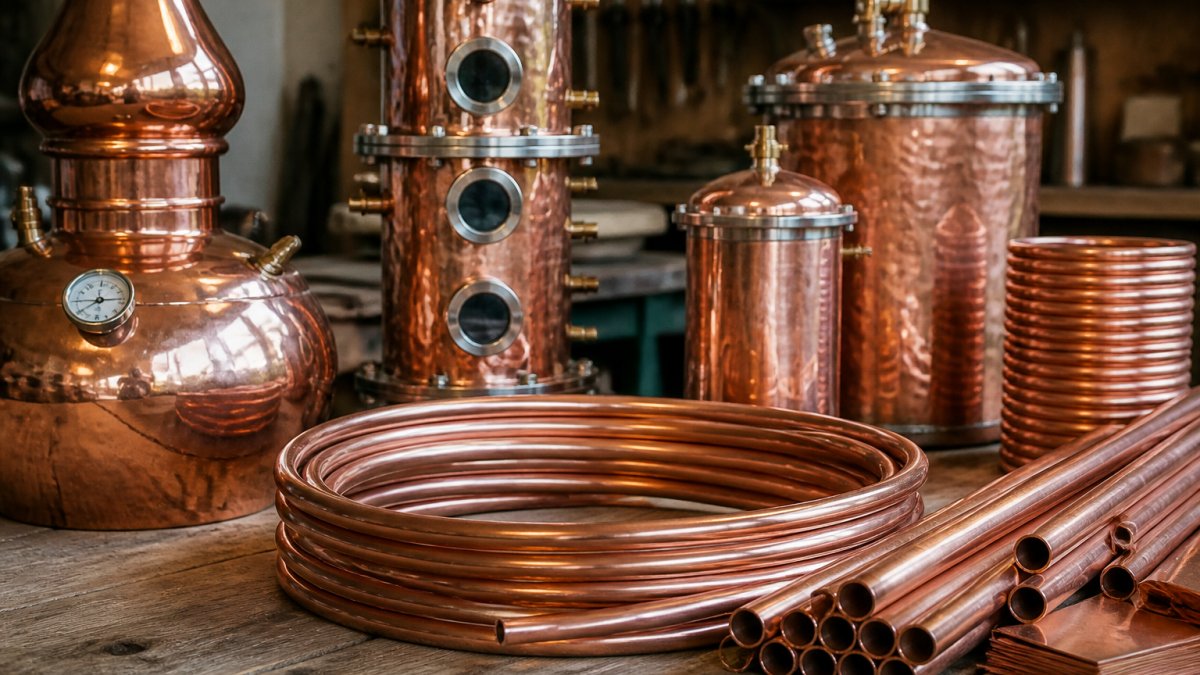
The reason to use 99.9% pure copper for stills comes down to thermal performance and chemical reactivity. High-purity copper moves heat evenly for a stable, predictable run, and presents the maximum reactive surface for binding sulfur compounds, so the copper does its cleanup job instead of sitting there as decoration.
Alloyed copper loses on both counts: zinc, lead, and other trace elements reduce conductivity and interrupt the crystalline structure that makes copper reactive. A still built from 99.9% pure copper with lead-free silver bearing solder delivers the intended performance with nothing extra in the vapor path.
Steven StillZ LLC builds every still from Paul Revere Copper, hand-made with machine-cut 20oz sheet and joined with 100% lead-free silver bearing solder. Each unit goes through rigorous water and air pressure testing before it ships, which is the part that matters when you're trusting a vessel with hot vapor.
Professional Verification: Spectrometer and Eddy Current Testing
A spectrometer is the only tool that returns an actual purity percentage. It reads the light emitted when a metal sample is excited and maps the wavelengths back to specific elements and concentrations, how you get from "probably copper" to "99.9% copper with these trace elements."
Two spectrometer types matter for copper work. X-ray fluorescence (XRF) is the common handheld option: non-destructive, takes seconds, and reports elemental composition down to parts per million for many elements. Optical emission spectrometry (OES) vaporizes a small sample, so it's destructive, but delivers higher accuracy on light elements. For a finished still, XRF is the practical choice; for raw sheet, OES gives a cleaner number.
Eddy Current Testing for Collectors
Eddy current testing is the non-destructive alternative collectors should know about. The instrument induces a magnetic field and measures how the metal responds, revealing conductivity and structural uniformity without cutting or damaging the piece, the practical choice for a finished still or vintage component.
The reading is conductivity, usually expressed as a percentage of the International Annealed Copper Standard (IACS). Pure annealed copper sits at 100% IACS by definition; a vintage vessel reading in the high 90s is consistent with high-purity copper, while the 40s or 50s points to brass or heavily alloyed bronze (copper.org). The instrument also flags cracks, voids, and thickness variation.
How to Actually Get a Test Done
You have three realistic routes:
Scrap yards and metal recyclers. Many will run a handheld XRF for a small fee, or free for regular customers. Call ahead to ask whether they use XRF or a conductivity meter, and whether they'll share a printed readout.
Local machine shops and welding fabricators. Shops working with aerospace or food-grade stainless often own an XRF gun for incoming material verification. Ask for a spot check on your part.
Metallurgical testing labs. For a formal report with a purity percentage and trace element breakdown, a lab is the answer. Expect to ship a sample or bring the part in; turnaround is typically a few business days, and pricing varies by lab and element count.
Calibrating Your Own Tools First
If you're comparing a lab reading against your home conductivity meter, calibrate the meter first. Most handheld eddy current meters ship with a reference standard: measure it, note the reading, and adjust if the meter allows. If it doesn't, record the offset and apply it to every reading.
Meters often read a few percent low on aged or oxidized copper because surface corrosion interrupts the eddy currents. Clean the test spot to bare metal with fine abrasive, then take three readings at different spots. If they disagree by more than a few percent, the part likely has inconsistent composition or internal flaws.
If you're buying equipment you'll use for years, ask the manufacturer for material certifications and test documentation. Steven StillZ LLC documents the copper grade and solder composition for every still it ships, so you can verify the claims instead of taking them on faith.
Frequently Asked Questions
How can I check the purity of copper at home?
Start with visual inspection, a magnet test, and a density check. High-purity copper is reddish-orange, non-magnetic, and should have a density near 8.96 g/cm³. For more accuracy, use a conductivity meter or a diluted acid test. These methods can flag obvious issues but cannot confirm 99.9% purity. For that, you need a spectrometer or eddy current tester. If a seller claims 99.9% pure copper, ask for a certificate of analysis from a third-party lab.
Will a magnet stick to pure copper?
No. Pure copper is diamagnetic, meaning it repels magnetic fields very weakly. A standard magnet will not stick. If a magnet sticks, the item contains iron, nickel, or steel. However, a magnet test alone cannot confirm purity. Some copper alloys, like brass or bronze, are also non-magnetic. Use the magnet test as a quick first check, then follow up with a density or conductivity test to rule out alloys.
Why is 99.9% pure copper preferred for distillation?
Copper is a catalyst that reacts with sulfur compounds in distillate, removing off-flavors and metallic tastes. Higher purity means more available copper surface for this reaction. Impurities like lead or iron can leach into the spirit or reduce thermal conductivity. Many craft distillers and hobbyists choose 99.9% copper because it delivers consistent results.
How do professionals verify copper purity in industrial settings?
Professionals use spectrometer analysis, such as X-ray fluorescence (XRF) or optical emission spectrometry (OES), to measure trace elements down to parts per million. They also use eddy current testing for non-destructive conductivity checks and electrodeposition techniques for precise plating thickness. These methods require calibration and trained operators. For collectors or small-scale buyers, third-party lab testing is the most reliable option. Always request a certificate of analysis that lists the purity percentage and testing method.