 how-to
How to Choose the Right Solder Wire
Last Updated: October 22, 2026
Quick Summary
How to choose the right solder wire starts with matching four factors: alloy composition, wire diameter, flux type, and your equipment. Lead-based 63/37 with rosin core and 0.032-inch diameter is the most versatile starting point for electronics work, while lead-free SAC305 is required for commercial or export applications.
- Lead-based 63/37 solder melts around 183°C and creates strong joints; lead-free SAC305 melts around 217°C and is mandated by RoHS for commercial electronics
- Wire diameter ranges from 0.020 to 0.125 inches, with 0.032 to 0.062 inches ideal for standard through-hole electronics and 0.020 to 0.032 inches for surface-mount work
- Rosin-core flux is standard for electronics; acid-core is for plumbing only; no-clean flux minimizes residue but costs more
- A 40-watt iron handles lead-based solder on small joints, while lead-free often requires 60 watts or more to reach proper working temperature
- Control fumes at the source with a fume extractor, wash hands after handling lead-based solder, and store wire dry in a sealed container
Table of Contents
- Understanding Solder Alloy Composition: Lead-Based vs. Lead-Free
- Solder Wire Diameter Guide: Matching Gauge to Your Work
- Rosin Core vs. Acid Core Solder: Flux Types Explained
- Best Solder Wire for Electronics: Choosing by Application
- Melting Point, Working Temperature, and Equipment Compatibility
- Safety, Ventilation, and Handling Best Practices
- Troubleshooting Solder-Wire Mismatches and Common Mistakes
- Frequently Asked Questions
Understanding Solder Alloy Composition: Lead-Based vs. Lead-Free
Understanding how to choose the right solder wire starts with alloy composition, which determines melting point, joint strength, and long-term reliability. Lead-based and lead-free solder behave very differently.
Lead-based solder melts at lower temperatures and creates strong, reliable joints, but regulatory pressure has shifted the industry toward lead-free alternatives in many applications.
Lead-Based Solder (60/40 and 63/37)
60/40 solder is 60% tin and 40% lead; 63/37 solder is 63% tin and 37% lead. The 63/37 ratio is eutectic, melting at a single temperature, which makes it easier to work with. Lead-based solder flows smoothly, wets well to copper and component leads, and its lower melting point (around 190°C for 63/37) means less heat stress on delicate electronics.
Lead-Free Solder and Regulatory Requirements
Lead-free solder typically uses tin, silver, and copper, with common formulations including SAC305. It melts at higher temperatures, around 220°C, and is mandated in the European Union under the Restriction of Hazardous Substances (RoHS) directive.
At Steven StillZ LLC, we use 100% lead-free silver bearing solder in every still we build. This ensures safety, compliance, and long-term reliability without compromise on joint quality.
Solder Wire Diameter Guide: Matching Gauge to Your Work
Wire diameter controls how much solder you deposit per unit of feed and how quickly it melts against the joint.
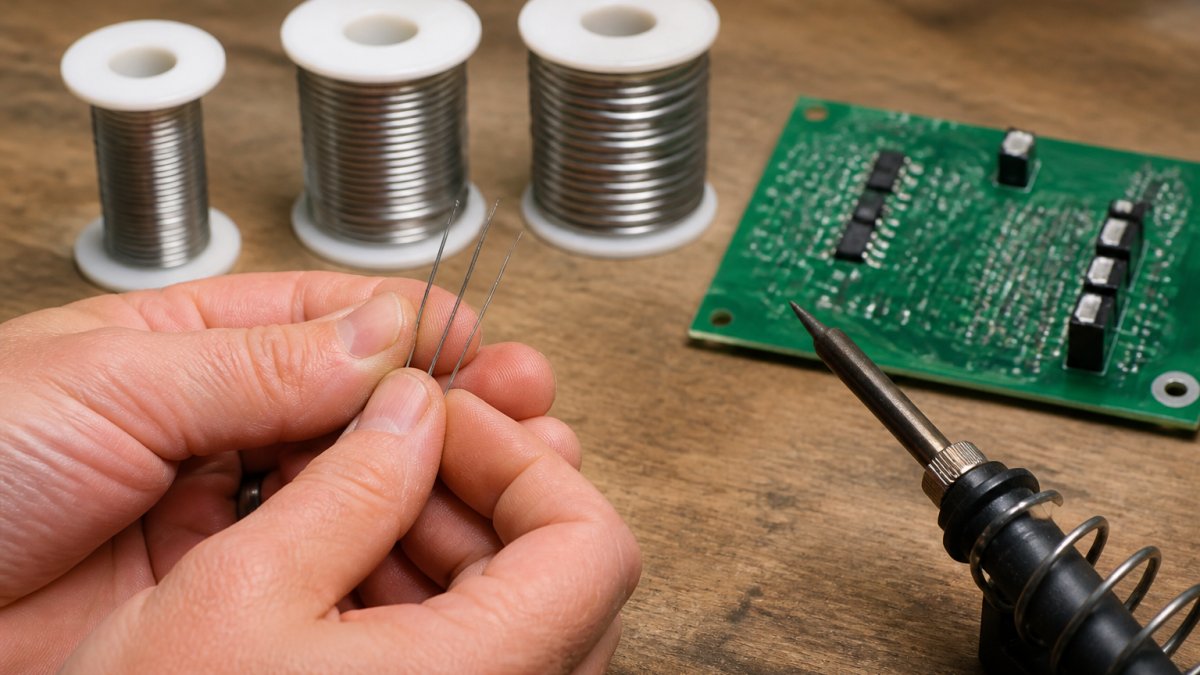
Common diameters run from about 0.020 inches to 0.125 inches. For most through-hole and general electronics work, 0.032 to 0.062 inches is the practical range. Surface-mount and fine-pitch work favors 0.020 to 0.032 inches.
Wire Diameter Selection Chart
| Application | Wire Diameter | Best For | Notes |
|---|---|---|---|
| Fine-pitch surface-mount, 0402/0603, fine IC leads | 0.020-0.025 inches | Tiny pads, dense boards | Precise control; pair with a fine conical or chisel tip and lower iron wattage |
| General surface-mount and small through-hole | 0.025-0.032 inches | 0805/1206, small headers, repair work | Good balance of control and feed rate for hand soldering |
| Standard through-hole electronics | 0.032-0.050 inches | Resistors, capacitors, DIP ICs, connectors | Most versatile range; forgiving for beginners |
| Large through-hole and power joints | 0.050-0.062 inches | Power connectors, thick leads, ground planes | Faster fill; needs a larger tip and more iron wattage to keep up |
| Heavy connections and copper tubing | 0.062-0.125 inches and up | Lugs, large terminals, plumbing joints over 0.5 inches | High thermal mass requires more solder volume and a hotter, higher-mass heat source |
How Diameter Interacts With Pad Size, Joint Volume, and Tip Size
The joint sets the upper bound on useful diameter: a small pad can only accept so much solder before it bridges, while a large ground plane wicks heat away so fast that thin wire melts before the joint reaches wetting temperature. Tip size should track wire diameter, a fine tip with thick wire can't transfer heat fast enough.
Fine-Diameter vs. Standard Gauge Wire
Fine-diameter wire (0.020-0.032 inches) gives precise, repeatable deposits for crowded boards and rework, but demands constant feeding. Standard gauge wire (0.032-0.062 inches) balances control and speed, covering most electronics work. Thick wire (0.062 inches and up) suits heavy-duty work, plumbing, power connections, large terminals, but is a poor choice for fine electronics.
Rosin Core vs. Acid Core Solder: Flux Types Explained
Flux is the chemical that cleans the joint surface and helps solder flow; it sits inside the wire as a hollow core. The flux type determines where you can use the solder and how you clean up. Three main types exist: rosin core, acid core, and no-clean.
Rosin-Core Flux for Electronics
Rosin-core flux is the standard for electronics work. Made from pine resin, it is safe for circuit boards, and its residue is non-conductive and non-corrosive. It flows smoothly on copper and component leads, and the residue can be left on the board or cleaned with isopropyl alcohol and a brush.
Acid-Core Flux and Plumbing Applications
Acid-core flux contains zinc chloride. It's aggressive and cleans heavily oxidized surfaces, making it ideal for plumbing work where copper tubing oxidizes quickly. Never use it on electronics: the residue is conductive and corrosive and will damage circuits over time. Acid-core solder is also called "plumbing solder", if you're joining copper pipes, this is your choice.
No-Clean Flux and Residue Management
No-clean flux leaves minimal, non-conductive residue that doesn't require cleanup, saving time in production. It costs more than rosin-core, so for hobbyist work the premium isn't worth it. No-clean is useful, however, if you're building something that will be sealed or potted, where residue inside an enclosure can trap moisture.
Best Solder Wire for Electronics: Choosing by Application
Learning how to choose the right solder wire depends on what you're soldering. A component's size, the joint's thermal demands, and your equipment all matter.
Through-Hole and Surface-Mount Soldering
Through-hole components (resistors, capacitors, connectors) need reliable joints that handle mechanical stress. Use rosin-core solder with a wire diameter of 0.032 to 0.062 inches; lead-based 63/37 or lead-free SAC305 both work well. Surface-mount components are tiny, so use fine-diameter rosin-core solder (0.020-0.032 inches); lead-free is increasingly standard here because RoHS compliance is common in consumer electronics.
Circuit Board Repairs and Electrical Components
Repairing existing circuit boards requires care: old boards have fragile copper traces, so use a lower-temperature solder (lead-based 63/37 if possible) to minimize heat stress. For electrical components like transformers and relay coils, match the original joint, adding lead-free solder to a lead-based board creates a mixed joint that may be weaker.
Melting Point, Working Temperature, and Equipment Compatibility
Solder's melting point determines the iron temperature you need: lead-based 63/37 melts around 183°C, lead-free SAC305 around 217°C. Your iron must reach the melting point plus 50-100°C to heat the joint effectively. A 40-watt iron works for lead-based solder on small components, while lead-free often requires 60 watts or more.
Safety, Ventilation, and Handling Best Practices
Soldering hazards come from two sources: metal content (lead in lead-based alloys) and flux chemistry (all fluxes emit fumes when heated). Handling both correctly is a matter of exposure control, not fear, a few consistent habits eliminate the bulk of risk.
Fume Control and Ventilation
Flux fumes are the most consistent exposure in hand soldering. Rosin-based fluxes produce visible fumes that irritate eyes and airways; no-clean fluxes still emit vapors even when residue is minimal. Use a fume extractor with a carbon filter positioned within a few inches of the joint so fumes are captured before they reach your breathing zone.
Lead Exposure and Hand Hygiene
Lead-based solder does not produce significant lead fume at normal iron temperatures, but it leaves lead residue on hands, tools, and the bench. The exposure route is ingestion, not inhalation: wash hands with soap and water after handling solder and before eating or drinking, and keep solder, dross, and trimmed leads away from food areas.
Flux Percentage and Residue Management
Flux-core percentage (the fraction of the wire's cross-section that is flux) affects how much cleaning chemistry reaches the joint. Higher percentages help on oxidized or dirty surfaces and on joints that take longer to heat, but leave more residue; lower percentages suit clean, well-tinned surfaces. For sensitive electronics, residue can trap moisture and cause leakage, so choose a flux level you're prepared to clean.
Storage and Shelf Life
Store solder wire in a cool, dry place. Moisture degrades flux and makes wire harder to work with, and old wire produces weaker joints and inconsistent flow. Keep it in its original spool or a sealed container, away from humid basements and temperature swings; if flux sputters or the wire oxidizes, replace it.
Regulatory and Workplace Context
Lead-free requirements are common in commercial electronics and workplaces with environmental or product-compliance policies. If you're building for sale, for a workplace, or for a customer with specifications, check the applicable requirements before choosing an alloy, project and workplace specifications can be stricter than general rules. For personal hobby work, lead-based solder remains legal in most contexts, but lead-free is the safer default when the work will be handled by others or used around children.
Troubleshooting Solder-Wire Mismatches and Common Mistakes
Poor results usually trace back to one of four issues: wrong wire diameter, wrong flux type, wrong alloy, or equipment mismatch.
Poor Wetting and Joint Strength Issues
Wetting is how solder flows and bonds to the surface; poor wetting means the solder beads up instead of flowing smoothly, leaving a dull, bumpy joint. Common causes:
- Dirty surfaces (oxidized copper, dust, or old flux residue)
- Iron temperature too low
- Solder alloy incompatible with the surface
Fix: Clean the joint area with a brush or solder wick, raise iron temperature by 20-30°C, and use fresh solder wire. If the problem persists, switch alloys, lead-free SAC305 wets better on heavily oxidized surfaces.
Corrosion, Residue, and Long-Term Reliability
Acid-core flux left on electronics causes corrosion, and rosin residue traps moisture and can cause electrical leakage.
Choosing the right solder wire comes down to matching four factors: alloy composition, wire diameter, flux type, and your equipment. Lead-based 63/37 with rosin core and 0.032-inch diameter is the most versatile starting point for electronics work. Lead-free SAC305 is required for commercial or export applications.
At Steven StillZ LLC, we understand the importance of quality soldering in distillation equipment. Every still is built with 99.9% pure copper and 100% lead-free silver bearing solder, then tested for leaks under water and pressure.
Frequently Asked Questions
What type of solder should I use for electrical wires and electronics?
For electronics work, use rosin-core, lead-free solder wire with a melting point around 217°C (423°F). Lead-free solder meets regulatory requirements and eliminates contamination risk. For small components and circuit boards, choose fine-diameter wire (0.032 inches or smaller). Rosin flux leaves minimal residue and is safe for sensitive electrical components. Avoid acid-core solder on electronics, it's designed for plumbing and metal work, not delicate circuits.
What is the difference between lead-free and leaded solder?
Lead-based solder (60/40 or 63/37 tin-to-lead ratio) melts at lower temperatures (around 190°C) and flows more easily, making it beginner-friendly. Lead-free solder contains tin, silver, and copper, melting at higher temperatures (217°C+) but offering regulatory compliance and no toxicity risk. Lead-free requires slightly hotter iron tips and better technique, but eliminates health hazards and contamination concerns. For professional-grade equipment, lead-free is often preferred.
What solder wire diameter should I use?
Wire diameter depends on component size and joint demands. Use 0.032-inch diameter for small electronics and circuit board repairs. Use 0.062-inch for standard through-hole soldering and general electrical work. Use 0.093-inch or larger for mechanical demands and plumbing applications. Fine-diameter wire gives better control on small components but requires steadier hand technique. Thicker wire suits larger joints and higher thermal demands. Check your soldering iron's tip size, it should match your wire diameter for efficient heat transfer.
Should I use rosin-core or solid solder wire?
Rosin-core solder includes flux inside the wire, eliminating the need for separate flux and making it ideal for electronics, circuit boards, and most repairs. The rosin flux cleans the joint and improves wetting without leaving corrosive residue. Solid wire requires manual flux application and is rarely used in modern electronics work. For electronics and electrical components, rosin-core is the standard choice. No-clean flux variants minimize residue cleanup, making them convenient for hobby and professional work alike.