 ultimate-guide
Is Silver Bearing Solder Safe? A 2026 Guide
Table of Contents
- What Is Silver Bearing Solder and Why It Matters for Your Still
- Silver Bearing Solder vs Lead-Free: What's the Difference?
- Lead-Free Solder Safety Standards You Should Know
- Food Grade Solder for Distillation: What to Look For
- Health Risks and Toxicity: What the Science Says
- Ventilation, Flux Safety, and Proper Handling
- DIY vs. Professional Application: Safety Considerations
- Conclusion
- Frequently Asked Questions
Last Updated: September 14, 2026
What Is Silver Bearing Solder and Why It Matters for Your Still
Silver bearing solder is a metal alloy used to join copper components, made primarily of tin with a small percentage of silver, and sometimes copper or bismuth, added to improve strength and flow. For distillation equipment, the solder is the weakest link in an otherwise inert copper system, which is why its composition matters so much. If you're asking is silver bearing solder safe, the short answer is yes, provided the alloy is genuinely lead-free and applied correctly. At Steven StillZ LLC, every still is assembled with 100% lead-free silver bearing solder and undergoes rigorous water and pressure testing to guarantee a leak-free experience for our customers, because a joint that fails is a safety problem, not just a quality problem.
The distinction that matters is between the solder and everything around it. A lead-free silver alloy is chemically stable once solidified. The risks people worry about come from leaded alternatives, flux residue left inside the vessel, or poor technique that leaves voids in the joint. Get those three right and the material is about as inert as the copper it bonds.
Silver Bearing Solder vs Lead-Free: What's the Difference?
Silver bearing solder and lead-free solder are not opposites. Silver bearing solder is a type of lead-free solder, distinguished by a small silver content that raises melting temperature slightly and improves joint strength and wetting on copper.
"Lead-free" describes what's absent; "silver bearing" describes what's added. You can have lead-free solder with no silver at all, and older stock may include silver-bearing alloys that still contain lead, which is why the label alone is not enough.
| Alloy Type | Typical Composition | Melting Range | Best For |
|---|---|---|---|
| Tin-silver | Tin with a few percent silver | Higher solidus/liquidus | Strong copper joints |
| Tin-copper | Tin with trace copper | Moderate | General plumbing |
| Tin-silver-copper | Tin, silver, copper | Higher range | Structural joints |
| Tin-bismuth | Tin with bismuth | Lower range | Heat-sensitive work |
For a still, you want an alloy that is both lead-free and formulated for potable water contact. Silver content helps with mechanical strength and corrosion resistance, which matters on a vessel that sees heat cycles and vapor.
Lead-Free Solder Safety Standards You Should Know
Lead-free solder safety standards in the United States center on the Safe Drinking Water Act and the plumbing codes that flow from it. Section 1417 of the SDWA prohibits the use of any pipe, fitting, solder, or flux that is not "lead free" in any public water system or plumbing providing water for human consumption (the EPA). The definition was tightened in 2014: solder and flux may contain no more than 0.2% lead, and wetted surfaces of pipes and fittings no more than a 0.25% weighted average (the EPA).
That 0.25% figure is worth understanding because it explains why "lead-free" is a threshold, not a promise of zero. The EPA's lead-free plumbing requirements set the framework, and manufacturers must document compliance. For distillation, the same logic applies: the material touching your vapor and condensate should meet or beat the potable water standard.
The standard most buyers never hear about is NSF/ANSI 61, "Drinking Water System Components, Health Effects." A solder or flux with an NSF/ANSI 61 listing has been tested for the metals and organic compounds it can leach into water under standardized exposure. A product that merely says "lead-free" has not necessarily been through that testing. For a still, an NSF/ANSI 61 listing is the strongest single indicator that the alloy and its flux residue are appropriate for contact with a consumable.
Alloy designations matter too. ASTM B32 covers solder metals, and common lead-free silver-bearing alloys are designated by tin, silver, and copper content, for example, the 95/5 tin-antimony family, the tin-silver family around 96/4, and the tin-silver-copper (SAC) family near 95.5/4/0.5. The pattern is consistent: high tin with a small silver addition, and no lead. If a supplier cannot state the alloy designation or composition percentages, the documentation is incomplete.
A common mistake is assuming any hardware-store solder labeled "lead-free" is appropriate. Many lead-free solders are formulated for electronics, not contact with liquid or vapor, and may contain flux cores not intended for ingestion-adjacent use. Check the material safety data sheet and intended application before you buy: the label tells you what is absent; the SDS and NSF listing tell you what is present and what it can do.
Food Grade Solder for Distillation: What to Look For
Food grade solder for distillation is a lead-free alloy explicitly rated for contact with potable water or food-contact surfaces, paired with a flux safe for that use. The alloy and flux are a package; one without the other is incomplete.
Here is what to verify before any solder touches your equipment:
- Alloy is documented as lead-free (0.25% or less lead by weighted average)
- Silver content is stated, not implied
- Flux is rated for potable water or food-contact use
- Material safety data sheet is available from the supplier
- Alloy is intended for copper-to-copper joints, not electronics
- Joint will be cleaned of external flux residue after cooling
How do you know the copper and solder are what the seller claims? Reputable builders document their materials and stand behind them. Steven StillZ LLC builds with 99.9% pure copper and lead-free silver bearing solder, and every unit undergoes rigorous water and pressure testing to guarantee a leak-free experience for our customers, so the claim is backed by a test rather than a label.
Health Risks and Toxicity: What the Science Says
Health risks with silver bearing solder fall into two categories: risks from the alloy itself and risks from the process. The solidified lead-free alloy is not a meaningful toxicity concern in normal use; the process is where the real hazards live.
Fume inhalation is the primary risk. Soldering heats metal and flux until both release vapors, and flux fumes are the bigger irritant, causing respiratory irritation with repeated exposure in poorly ventilated spaces. Metal fume fever is associated with welding and high-heat metal work, not typically plumbing soldering, but the principle of ventilation holds regardless.
Hot liquid metal is the second hazard. Molten solder causes serious burns, and it can spatter. Eye protection and long sleeves are not optional.
Heavy metal contamination is a concern only when leaded solder is involved. This is exactly why lead-free alloys matter for anything touching consumables.
Silver and tin are not classified as significant systemic toxins at the trace levels present in solder. The concern is cumulative exposure to flux fumes over years of work, a ventilation and PPE problem, not an alloy problem.
Ventilation, Flux Safety, and Proper Handling
Ventilation requirements for soldering are straightforward: work where fumes cannot accumulate around your face, and use active extraction indoors. An open window is not ventilation if the air is still. Flux begins to decompose and release fumes well below the temperature at which solder melts, rosin-based fluxes produce visible fumes at the range where an iron or torch is already hot enough to work the joint, so exposure begins before the solder flows.
Flux is the part of the process most people underestimate. It cleans the metal surface and prevents oxidation during heating, producing fumes and residue in the process. There are three broad flux families:
- Rosin-based flux (including activated rosin): the traditional plumbing and electronics flux. Effective on copper, but the fumes are a known respiratory irritant with repeated exposure. The residue is sticky and must be cleaned.
- Organic acid flux (water-soluble): easier to clean because the residue dissolves in water, but the acid residue is corrosive if left on the joint. It must be removed thoroughly, not just wiped.
- Inorganic acid flux: aggressive, used for heavy-duty metal work, and not appropriate for potable water or food-contact equipment. If a product does not state its flux type, assume the worst and do not use it on a still.
"No-clean" flux is a fourth category, and the one most often misapplied. "No-clean" means the residue can be left on an electronics assembly without corrosion or electrical leakage, not that it is safe inside a vessel touching a consumable. For any still: use a flux rated for potable water contact, and clean external residue after the joint cools.
Cleaning is mechanical, not wipe-and-hope. After the joint cools enough to handle but before residue hardens, wipe the exterior with a damp cloth, then use a flux remover matched to the flux chemistry: warm water for water-soluble residue, alcohol-based or commercial remover for rosin. Residue trapped inside a sealed vapor path is the failure mode to avoid, which is why joint geometry matters as much as cleaning, a fitting that traps flux in a crevice cannot be cleaned after the fact.
For personal protection, the practical minimum is eye protection against spatter, long sleeves and gloves against molten solder, and local exhaust ventilation or an organic-vapor respirator for extended indoor work. The alloy is not the airborne concern; the flux decomposition products are.
DIY vs. Professional Application: Safety Considerations
DIY soldering is safe when the person understands three things: the alloy, the flux, and the heat. Where DIY goes wrong is usually technique, not materials. A cold joint, where solder did not fully flow into the fitting, looks fine outside and fails under pressure or heat cycling.
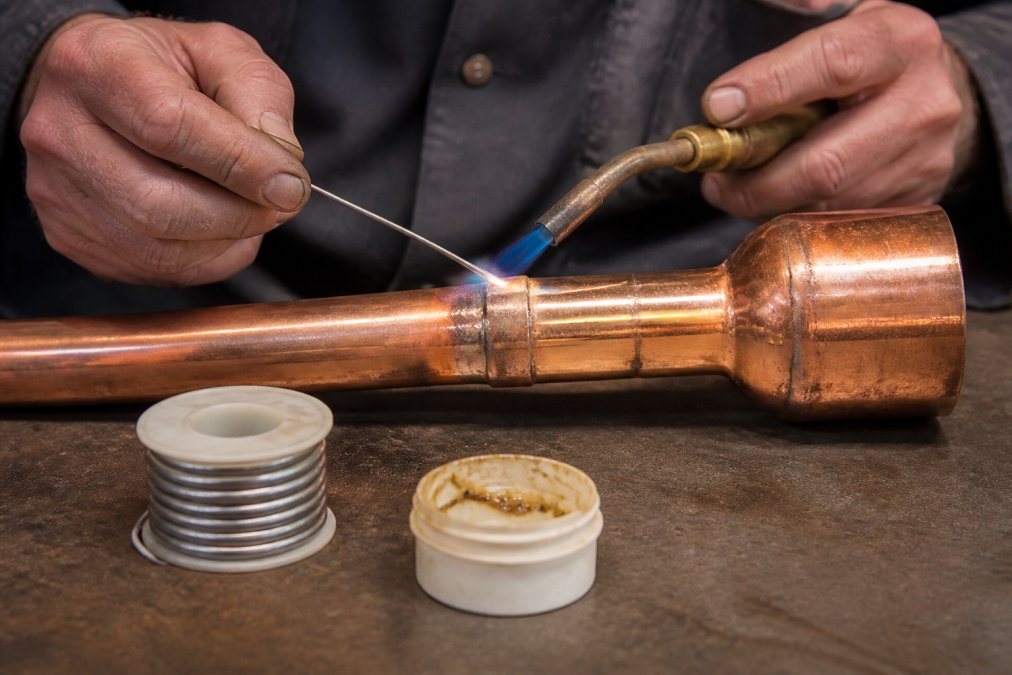
Pipe sweating, heating a copper joint so capillary action pulls solder into the gap, requires steady heat and clean mating surfaces. Too little heat and the solder sits on top; too much and you oxidize the copper and burn the flux. Neither failure is obvious to an untrained eye.
The professional case is not about skill for its own sake. It is about verification. A builder who performs rigorous water and pressure testing on every unit catches the failures that a hobbyist cannot see. That is the real difference between a still that is safe to run and one that merely looks finished.
Disposal is the angle most guides skip. Solder scraps, flux containers, and dross should not go in household trash in many jurisdictions, check local rules for metal and chemical waste. Lead-free solder scrap is generally recyclable as metal, and flux containers should be disposed of per their safety data sheet.
If you are weighing a cheaper unit against a professionally built one, the question to ask is not "will it hold together on day one" but "was it tested." Steven StillZ LLC performs rigorous water and pressure testing on every still and backs each one with a 100% money-back or replacement guarantee, which is the practical version of that answer.
Conclusion
Whether silver bearing solder is safe has a clear answer, but it depends on the alloy being genuinely lead-free, the flux being rated for the application, and the joint being sound. Get all three right and the material is inert, durable, and appropriate for equipment that touches consumables. Get any one wrong and the failure shows up in taste, leaks, or exposure you did not plan for. Steven StillZ LLC builds every still from 99.9% pure copper with 100% lead-free silver bearing solder, rolls, hems, and beads each part for structural integrity, and every still undergoes rigorous water and pressure testing to guarantee a leak-free experience for our customers. Order online 24/7 and get a still that is built to be verified, not just described.
Frequently Asked Questions
Is silver bearing solder food safe?
Yes, when it is lead-free and meets NSF/ANSI 61 standards. Silver bearing solder typically contains silver, tin, and copper, with no lead. The Safe Drinking Water Act requires lead-free materials for potable water applications. For distillation equipment, look for solder explicitly labeled lead-free and compliant with plumbing codes. Always check the material safety data sheet for alloy composition and verify it is intended for food-grade use.
Does silver bearing solder contain lead?
No, modern silver bearing solder for plumbing and food-grade applications is lead-free. It is formulated with silver, tin, and copper, and sometimes bismuth, to achieve the desired melting range and strength. However, older or industrial silver solders may contain lead, so always check the label and material safety data sheet. For distillation, only use solder that is certified lead-free and safe for potable water.
How does silver bearing solder compare to traditional plumbing solder?
Traditional plumbing solder often contained lead, which is now banned for potable water systems under the Safe Drinking Water Act. Silver bearing solder is lead-free and offers better mechanical strength and corrosion resistance. It also has a higher melting range, which can be an advantage for high-temperature applications like distillation. The silver content improves capillary action and joint integrity, making it a preferred choice for copper piping in stills.
What are the disadvantages of silver bearing solder?
Silver bearing solder costs more than standard lead-free solder due to the silver content. It also requires higher heat, which can be challenging for beginners and may necessitate a more powerful torch. The higher melting range means you need to be careful not to overheat nearby components. Additionally, flux residue must be cleaned thoroughly to prevent contamination. Despite these drawbacks, the benefits for distillation equipment often outweigh the costs.