 listicle
Premium Distillation Equipment for Sale: 2026 Guide
Table of Contents
- What Defines Premium Distillation Equipment for Sale in 2026
- Copper vs Stainless Steel Stills: Which Material Wins?
- Best Copper Still for Home Distilling: Top Picks for Serious Hobbyists
- Distillation Equipment Safety Standards Every Buyer Should Know
- Turnkey Systems vs. Modular Stills: Which Configuration Fits Your Needs?
- Regulatory Compliance and Energy Efficiency: What Competitors Miss
- Conclusion: Choosing Your Premium Distillation Equipment
- Frequently Asked Questions
Last Updated: September 25, 2026
What Defines Premium Distillation Equipment for Sale in 2026
Premium distillation equipment for sale in 2026 is defined by verified material purity, documented pressure testing, and precision engineering, not a shiny catalog photo. At Steven StillZ LLC, we hand-build every still from 20oz Paul Revere Copper and 99.9% pure copper stock, then water- and air-pressure test each unit before shipping.
Key Components of a Professional System
A professional still is a chain of parts, and every link affects distillate purity. The boiling flask or pot holds the wash and receives heat from a heating mantle or burner. The fractionating column separates vapor by boiling point, the condenser cools it back to liquid, a vacuum pump lowers boiling temperatures for heat-sensitive work, and a pressure gauge plus safety valve keep the system within safe limits.
Three details separate lab-grade builds from hobby kits:
- Hermetic seal quality at every joint, which prevents vapor loss and contamination
- Digital temperature control for repeatable runs instead of guesswork
- Corrosion-resistant internals that survive acidic washes and high-proof vapor
Copper vs Stainless Steel Stills: Which Material Wins?
Copper wins for spirit distillation because it conducts heat efficiently and strips sulfur compounds that create off-flavors. Stainless steel wins on cost, cleaning ease, and resistance to acidic washes. The right choice depends on what you distill and how often.
Why Copper Remains the Gold Standard
Stainless steel earns its place for water distillation and high-volume neutral spirit work, where flavor stripping is not a concern. Where flavor matters, copper is the better investment.
Best Copper Still for Home Distilling: Top Picks for Serious Hobbyists
The best copper still for home distilling balances capacity, material quality, and heat flexibility against a hobbyist's space and budget. Prioritize copper thickness and joint quality over capacity, a well-built 10-gallon still outperforms a flimsy 20-gallon one.
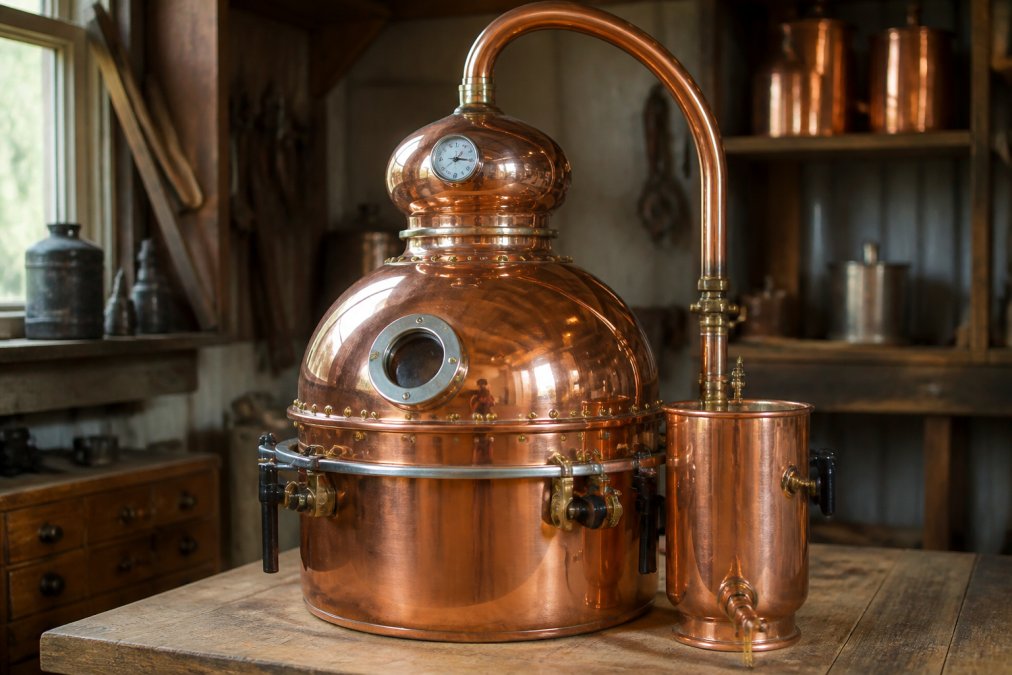
Steven StillZ LLC: Handcrafted Paul Revere Copper Stills
Our top pick is Steven StillZ LLC, because every unit is hand-built from Paul Revere Copper with machine-cut, 20oz, 99.9% pure copper and 100% lead-free silver bearing solder. Each still undergoes water and air pressure testing before shipping, so leak-free performance is verified rather than promised.
What sets the build apart:
- Rolled, hemmed, and beaded parts for structural integrity that survives years of heating cycles
- Lead-free silver bearing solder throughout, addressing the contamination concern most buyers raise
- A 100% money-back or replacement guarantee if the still does not perform as described
Mile Hi Distilling: Modular Kits for Flexible Setups
| Option | Best For | Material | Standout Feature |
|---|---|---|---|
| Steven StillZ LLC | Hobbyists wanting a finished, tested copper still | 20oz Paul Revere Copper, lead-free solder | Hand-built, pressure-tested, money-back guarantee |
| Mile Hi Distilling | Tinkerers building a system over time | Varies by kit | Large parts catalog and educational resources |
| ABE Equipment Hybrid Still | Craft distilleries needing flexibility | Hybrid pot/column design | Customizable for multiple spirit types |
| Olympic Distillers 400 Gallon | Commercial high-volume production | Professional-grade, 4-plate column | 400-gallon capacity, listed at $56,995 |
Distillation Equipment Safety Standards Every Buyer Should Know
Safety standards for distillation equipment center on pressure integrity, vapor containment, and heat control. A still is a sealed vessel handling flammable vapor, so the difference between safe and dangerous comes down to testing and component quality, not features.
Pressure Testing and Leak Prevention
What to verify before you buy:
- Written confirmation of pressure testing on the specific unit, not the product line
- A functioning pressure gauge and safety valve rated for the system's maximum output
- Lead-free solder certification, since lead contamination is a genuine health risk in distillate
- Hermetic seal quality at every joint, verified with a leak test on arrival
- Clear documentation of corrosion-resistant materials for the wash-contact surfaces
For buyers in the United States, distillation of spirits requires compliance with federal and state rules, and equipment ownership does not grant a distilling permit. Check current requirements with the Alcohol and Tobacco Tax and Trade Bureau before purchasing for spirit production.
Turnkey Systems vs. Modular Stills: Which Configuration Fits Your Needs?
Turnkey systems arrive assembled, pressure-tested, and ready to run; modular stills ship as components you configure over time. The real difference is where the integration risk, lead time, and cost of ownership land.
What "Turnkey" Actually Includes
A true turnkey package is more than a still. A complete commercial configuration typically bundles:
- Boiler or pot sized to your batch volume, with a matched heating mantle or steam jacket
- Fractionating column with the plate count your spirit style requires (4 plates for whiskey and rum, more for neutral spirit)
- Condenser and chiller unit sized to the column's vapor load
- Vacuum pump if you run heat-sensitive botanicals or low-temperature stripping
- Pressure gauge, safety valve, and digital temperature control wired and calibrated
- Plumbing, gaskets, and a documented pressure test on the assembled unit
What Modular Saves, and What It Costs
Modular stills let you buy a base pot and column now, then add plates, a gin basket, or a larger condenser later. That flexibility shifts three costs onto you:
- Integration labor. You source compatible fittings, verify seal quality at every joint, and re-test the assembled vessel before first run.
- Downtime between upgrades. Each change requires a new leak test and a re-calibration of your temperature control.
- Parts compatibility risk. Mixing components from different makers is where most seal failures and pressure issues originate.
Matching Configuration to Throughput
Capacity drives the decision more than preference. As a rough guide:
| Buyer Profile | Typical Capacity | Configuration That Fits |
|---|---|---|
| Home hobbyist | 5-20 gallons | Modular copper pot still, single column |
| Serious hobbyist / small craft | 20-100 gallons | Turnkey copper pot or hybrid, 2-4 plates |
| Craft distillery | 100-400 gallons | Turnkey hybrid or column system, 4+ plates, steam or mantle heat |
| Lab / botanical extraction | Bench scale | Turnkey glass-and-copper vacuum system with digital control |
The ROI Question Commercial Buyers Should Ask
Premium equipment is a capital purchase, and the payback math is straightforward. Compare:
- Purchase price of the turnkey system versus the modular build-out
- Throughput per run (gallons of wash processed per batch) times runs per month
- Yield per run, a tighter hermetic seal and precise digital temperature control reduce vapor loss and raise usable distillate
- Energy cost per run, driven by heating element wattage and insulation
- Downtime cost from leaks, re-tests, and parts sourcing
Lead Time and Accountability
Turnkey units from a single maker carry one point of accountability: if the unit leaks, the maker owns it. Modular builds spread that responsibility across every supplier, fine when everything works, painful when it does not. Hand-built turnkey systems carry longer lead times because they are assembled and tested to order, a tradeoff worth planning around if you have a launch date.
Regulatory Compliance and Energy Efficiency: What Competitors Miss
Two topics most equipment listings skip are regulatory compliance and energy efficiency, and both affect total cost of ownership. Compliance determines whether you can legally operate; energy efficiency determines monthly running costs. A third, troubleshooting, determines how much downtime you absorb.
The Compliance Layer Most Buyers Miss
Rules apply at three levels, and equipment ownership grants none of them:
- Federal. Distilling spirits requires a permit and excise compliance through the Alcohol and Tobacco Tax and Trade Bureau. Fuel alcohol and water distillation fall under different rules than beverage spirits, confirm which category your intended use falls into before you buy.
- State. Licensing, zoning, bonding, and reporting requirements vary widely by state, and some states are far more restrictive than the federal floor. A system that is legal in one state may be unlicensed in another.
- Local. Fire codes, occupancy limits, and zoning for a production space often apply on top of state licensing, particularly for commercial-scale equipment.
Energy Efficiency: Where the Money Actually Goes
Heating is the dominant energy cost in any distillation run. The variables that matter:
- Heating element wattage versus batch size. An undersized mantle runs continuously and still struggles to reach temperature; an oversized one cycles hard and scorches wash. Match wattage to boiler volume.
- Insulation on the column and boiler. Uninsulated copper radiates heat the whole run. Wrapping the column and boiler is one of the cheapest efficiency upgrades available.
- Digital temperature control versus manual adjustment. A controller holds setpoint within a narrow band, which reduces wasted energy and produces more repeatable cuts. Manual burner adjustment drifts and forces you to re-run.
- Chiller sizing. An undersized chiller runs continuously and still cannot condense full vapor load; an oversized one short-cycles. Size to peak vapor rate, not average.
- Vacuum operation. Running under vacuum lowers boiling temperature, which cuts the heat energy required per run, a meaningful saving for heat-sensitive or botanical work.
Troubleshooting the Failures That Actually Happen
- Vapor leaks at joints. Usually a failed gasket or a joint that was never re-tested after assembly. Re-test with air pressure before every run after any change.
- Temperature drift. Often a failing controller probe or a mantle losing contact with the boiler. Verify probe calibration before assuming the controller is bad.
- Slow or incomplete condensation. Almost always a chiller or flow-rate problem, not a condenser problem. Check coolant temperature and flow before replacing hardware.
- Pressure not holding under vacuum. Look for a seal at the pump connection or a cracked gasket before suspecting the vessel itself.
- Off-flavors in the finished product. Frequently a materials or heat-distribution issue rather than a recipe issue, thin-gauge copper and hot spots both show up in the distillate.
For commercial buyers weighing a larger investment, the U.S. Small Business Administration publishes guidance on equipment financing that applies to capital purchases like a commercial still.
Conclusion: Choosing Your Premium Distillation Equipment
The hardest part of buying premium distillation equipment is separating verified quality from marketing claims, because most listings describe materials without proving them. Buyers who get it right ask for pressure-test documentation, solder composition, and copper gauge before they pay.
Frequently Asked Questions
What features define premium distillation equipment?
Premium distillation equipment is defined by high-quality materials like 99.9% pure copper, lead-free solder, and rigorous pressure testing. Look for features such as hermetic seals, digital temperature control, and modular designs that allow for upgrades. Brands like Steven StillZ LLC use Paul Revere Copper and hand-built construction to ensure structural integrity and leak-free performance. These features directly impact distillate purity and safety.
How much does premium distillation equipment cost?
Pricing for premium distillation equipment varies widely based on capacity, materials, and configuration. For specific pricing on handcrafted copper stills, contact Steven StillZ LLC directly for a quote tailored to your needs.
Why is copper preferred over stainless steel for distillation?
Copper offers superior thermal conductivity and can bind with sulfur compounds, removing off-flavors and improving distillate purity. It also provides natural antimicrobial properties. Stainless steel is durable and easier to clean, but it lacks copper's catalytic benefits. Many professional distillers choose copper for the boiler and column, while using stainless steel for other components. The choice depends on your spirit type and desired flavor profile.
What safety standards should I look for in distillation equipment?
Prioritize equipment that undergoes rigorous water and air pressure testing to ensure leak-free operation. Look for lead-free solder and food-grade materials. Safety valves, pressure gauges, and hermetic seals are essential. In the U.S., home distillation of alcohol requires compliance with federal and state regulations; always check local laws. Steven StillZ LLC pressure-tests every unit and uses 100% lead-free silver bearing solder for safety.
How do I maintain copper distillation equipment for longevity?
Clean copper stills after each use with warm water and a mild detergent, then dry immediately to prevent oxidation. Avoid abrasive scrubbers that can scratch the surface. Periodically polish with a copper cleaner to maintain shine and conductivity. Inspect seals and gaskets for wear, and replace as needed. Store in a dry environment. Regular maintenance ensures optimal performance and extends the life of your premium distillation equipment.