 Listicle
What Are 5 Essential Features of Professional Grade Copper Stills?
Last Updated: October 30, 2026
Quick Summary
Professional grade copper stills are defined by five measurable features: 99.9% pure copper for heat conductivity and flavor protection, lead-free silver bearing solder in the vapor path, documented water and air pressure testing, solid copper in the vapor path rather than a thin liner, and heat source compatibility with stated pressure ratings and serviceable parts. Verify each in writing before you buy.
- Ask the maker for copper weight and gauge in writing before you buy.
- Solder joints sit in the vapor path, so lead-free solder is a safety requirement.
- Steven StillZ LLC water tests and air pressure tests every still before it ships.
- A thin copper liner over stainless gives far less reactive surface than a solid copper boiler.
- Confirm the boiler, column, and fittings have a stated maximum working pressure.
Table of Contents
- Why Professional Grade Copper Stills Start With Material Verification
- Feature 1: Copper Still Purity and Heat Conductivity That Protects Flavor
- Feature 2: Lead-Free Solder for Stills and Fabrication Quality You Can Inspect
- Feature 3: Copper Still Leak Testing and Pressure Verification
- Feature 4: Copper Still vs Stainless Steel: Which Metal Belongs in Your Setup
- Feature 5: Heat Source Compatibility, Safety Limits, and Serviceability
- Order a Still Built to These Five Standards
- Frequently Asked Questions
Why Professional Grade Copper Stills Start With Material Verification
Most buyers judge a still by its shine. That is the wrong test. Professional grade copper stills are defined by what you can measure: copper purity, wall thickness, solder composition, and pressure integrity. Steven StillZ LLC builds its stills from 99.9% pure copper with lead-free silver bearing solder, and each unit is pressure tested before it ships. Below are the five features that separate a serious still from a decorative one, and how to check each yourself.
Copper Grade, Thickness, and How to Verify It Yourself
Copper grade is the first thing to confirm before you buy.
Thickness matters just as much. Ask the maker for the copper weight and gauge in writing before you buy.
You can verify grade without a lab. Check the mill stamp, weigh the unit against its stated sheet gauge, and inspect cut edges for uniform color. For a full walkthrough, see our guide on how to verify copper purity. Copper Development Association guidance on copper grades
Feature 1: Copper Still Purity and Heat Conductivity That Protects Flavor
Purity is what makes this work. Alloyed copper with filler metals conducts less predictably and can introduce off notes. A still built from 99.9% pure copper gives you the conductivity and sulfur-scrubbing surface you paid for. For a deeper look at wall gauge and heat transfer, read our breakdown of the best copper thickness for stills.
Feature 2: Lead-Free Solder for Stills and Fabrication Quality You Can Inspect
Lead-free solder is a safety requirement for stills, because solder joints sit in the vapor path.
Ask what alloy the maker uses and whether they can document it. Our guide on how to identify lead-free solder shows what to look for when inspecting a still's fabrication.
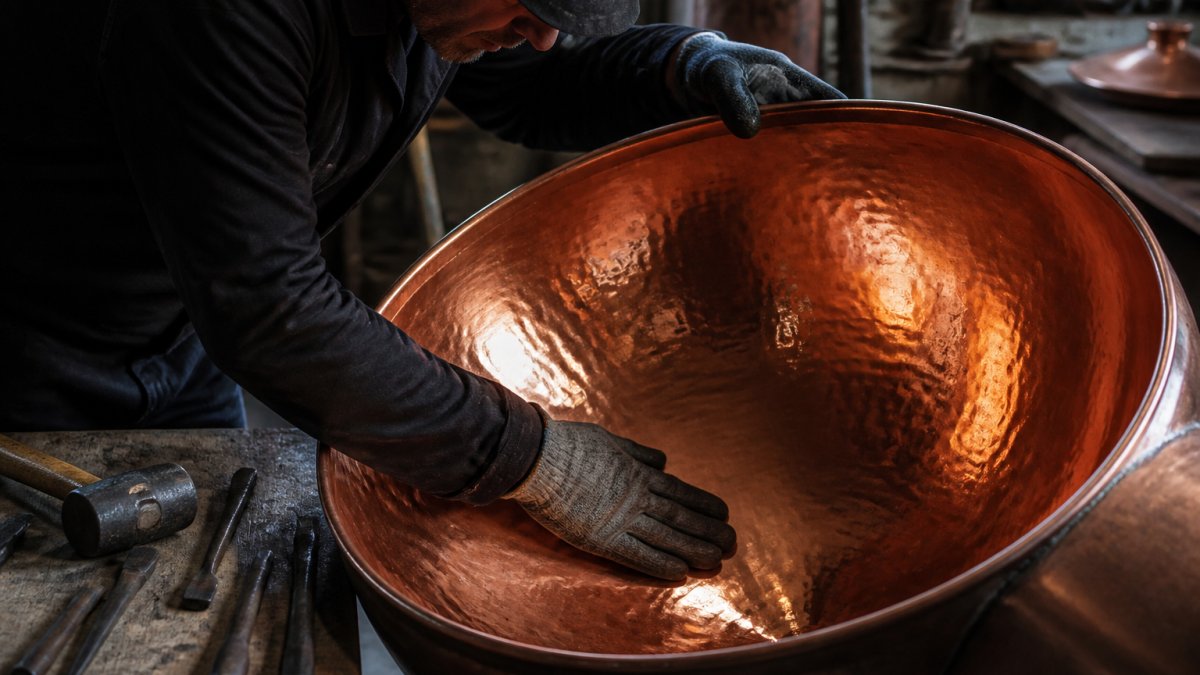
Fabrication quality shows in the details. Parts are rolled, hemmed, and beaded for structural integrity.
Feature 3: Copper Still Leak Testing and Pressure Verification
A leak at a seam or fitting wastes product and ruins runs.
Ask for proof of testing. You can also run your own checks with our step-by-step guide to testing a still for leaks. Steven StillZ LLC water tests and air pressure tests every still before it ships.
Feature 4: Copper Still vs Stainless Steel: Which Metal Belongs in Your Setup
Copper still vs stainless steel is not a brand preference question. It is a materials-engineering decision affecting heat transfer, flavor chemistry, maintenance intervals, and long-term cost of ownership. Here is the comparison a serious buyer needs.
Thermal Performance: Conductivity, Response Time, and Heat-Up
The measurable consequence is heat-up time and temperature stability. A copper boiler typically reaches operating temperature faster and holds a more uniform wall temperature, translating to shorter ramp times, more consistent cuts, and better repeatability. Ask the builder for wall gauge and heat-up data at your intended batch size.
Flavor Chemistry: Sulfur Binding and the Copper Surface
The professional-grade question is not whether copper removes sulfur but how much copper surface is in contact with vapor. A thin copper liner over stainless gives you far less reactive surface than a solid copper boiler and column. If flavor control is the goal, specify solid copper in the vapor path, not a decorative copper shell.
Corrosion, Patina, and Cleaning Intervals
For professional use, plan cleaning intervals around your run schedule. Copper surfaces in the vapor path should be inspected and cleaned regularly to maintain sulfur-binding capacity; a heavily fouled copper surface loses effectiveness. Stainless components in the condenser and supporting hardware reduce polishing labor without sacrificing flavor chemistry where it matters.
Cost, Lifespan, and Total Cost of Ownership
A professional buyer should compare total cost of ownership over the expected service life, not sticker price. Factor in heat-up energy, cleaning labor, replacement parts, and the value of consistent product quality. For flavor-driven spirit production, copper usually wins on that basis. For neutral or water distillation, stainless is often the more economical choice.
Application Fit: When to Use Each Metal
| Consideration | Copper | Stainless Steel |
|---|---|---|
| Thermal conductivity | ~400 W/m·K, fast and even | ~14-16 W/m·K, slower and uneven |
| Sulfur compound removal | Yes, binds reactive compounds | No, chemically inert |
| Corrosion resistance | Good, develops patina | Excellent, resistant to most wash chemistry |
| Cleaning and upkeep | Regular cleaning and polishing | Simple wipe-down |
| Repairability | Re-solderable and re-formable | Often requires assembly replacement |
| Best for | Flavor-driven spirit runs | Neutral or water distillation |
Feature 5: Heat Source Compatibility, Safety Limits, and Serviceability
Heat source compatibility, safety limits, and serviceability are the features buyers most often overlook, and exactly where professional-grade stills separate from entry-level equipment.
Heat Source Compatibility: Matching the Still to Your Setup
Direct flame, electric heating elements, oil baths, and steam jackets each deliver heat differently, and the still's construction must match the intended source.
- Direct flame: Requires a boiler bottom thick enough to spread flame heat without localized overheating. Thin copper can warp or develop stress cracks under direct flame. Confirm the bottom gauge and whether the builder recommends a heat diffuser.
- Electric elements: Require properly rated fittings, sealed electrical connections, and element watt density matched to the boiler size. Ask whether the element is direct-immersion or external, and confirm the electrical enclosure is rated for the environment.
- Oil bath: Provides gentle, uniform heat and is common for delicate washes. The boiler must be compatible with the bath medium and stable at operating temperature.
- Steam jacket: The most controllable option for commercial scale. Requires pressure-rated jacket construction and appropriate safety valves.
Ask the builder for the maximum recommended operating temperature and the pressure rating of the boiler and fittings.
Safety Limits: Pressure Ratings, Vapor Handling, and Electrical Classification
Confirm the following before purchase:
- Pressure rating: The boiler, column, and fittings should have a stated maximum working pressure, and the still should be vented to atmosphere during normal operation. Never operate a sealed system without a pressure relief device.
- Vapor path integrity: Every joint in the vapor path should be leak-tested. Ask for documentation of water and air pressure testing.
- Electrical classification: If you use electric heating near high-proof vapor, components should be rated for the environment. Explosion-proof motors and sealed electrical enclosures are appropriate where flammable vapor may be present. Reference the applicable electrical code requirements for your installation with a licensed electrician.
Serviceability: Parts, Access, and Long-Term Support
A still you can maintain is a still that lasts. Serviceability is the feature buyers forget to ask about until something fails.
Evaluate these criteria:
- Replacement parts availability: Ask whether gaskets, seals, fittings, condensers, and heating elements are stocked and available individually. A builder who cannot supply common wear parts leaves you dependent on custom fabrication.
- Access for cleaning and inspection: The boiler opening, column connections, and condenser should be accessible without disassembling the entire system. Tri-clamp fittings and removable components simplify maintenance.
- Repairability: Copper can be re-soldered and re-formed by a skilled fabricator. Ask whether the builder supports repairs and whether they will document solder alloy and procedure so a local fabricator can match it.
- Warranty and support terms: Confirm what the warranty covers, how long it lasts, and whether it includes parts, labor, or both. Ask how to reach support and what the typical response time is.
A Practical Pre-Purchase Checklist
Use this checklist to compare stills on the criteria that matter for heat source, safety, and serviceability:
- Stated maximum working pressure for boiler, column, and fittings.
- Documented water and air pressure test results.
- Heat source compatibility confirmed in writing for your intended setup.
- Electrical components rated for the installation environment.
- Pressure relief and venting provisions.
- Replacement parts list with availability and lead times.
- Access points for cleaning and inspection.
- Warranty terms and repair support documented.
Federal requirements for distilled spirits operations
Order a Still Built to These Five Standards
That is exactly how we build at Steven StillZ LLC. Every still is hand-made from 20oz, 99.9% pure Paul Revere Copper with 100% lead-free silver bearing solder, and parts are rolled, hemmed, and beaded for structural integrity. Each unit goes through rigorous water and air pressure testing, and every purchase is backed by a 100% money-back or replacement guarantee.
Ready to stop guessing and start distilling? Shop StillZ and order a still built to these five standards, online 24/7.
Frequently Asked Questions
What features should you look for in a professional grade copper still?
Start with the checks this business supports: 99.9% pure copper, lead-free silver bearing solder, water and air pressure testing on every unit, and rolled, hemmed, and beaded construction. Ask the maker for the copper grade and ounce weight, and confirm the still was pressure tested before shipping. A professional grade copper still should also list which heat sources it supports so you are not locked into one setup.
What copper purity is suitable for a still?
Commercially pure copper at 99.9% is the benchmark for professional grade copper stills. Thickness is listed alongside purity in this business's specifications: 20oz copper. Ask for the purity figure and the ounce weight in writing before you buy.
Is a copper still better than a stainless steel still?
They solve different problems. Copper conducts heat faster and reacts with sulfur compounds, which reduces off-flavors in the distillate. Stainless steel resists corrosion and needs less upkeep but does not remove sulfur compounds, so flavor correction depends entirely on your process. Many craft distillers run a copper pot still or copper column for flavor work and use stainless for storage. The copper still vs stainless steel decision usually comes down to whether flavor purity or low maintenance matters more to you.
How can you check whether a copper still is leak-free?
A reputable maker performs water and air pressure testing on every unit and can tell you the test method. When your still arrives, fill it with water and inspect every seam, fitting, and solder joint for weeping. Contact the maker if you find a leak at a joint.
What type of solder should be used in a copper still?
Lead-free silver bearing solder is the standard for stills that contact distillate or vapor. Lead solder has no place in equipment used for drinking spirits, and even lead-free plumbing solder varies in silver content and strength. Ask the maker to confirm the solder alloy and that it is lead-free, then inspect joints for smooth, fully filled seams rather than lumpy patches.