 How-to
How to Find the Causes of Metallic Taste in Spirits
Last Updated: November 9, 2026
Quick Summary
A metallic taste in spirits is a flavor defect caused by metal ions, reactive compounds, or contamination entering the spirit somewhere between the mash and the glass. The seven common causes are metal ions, water chemistry, raw materials, poor cleaning, reactive solder or cheap alloys, storage and glassware, and taste perception issues. The first three account for most cases.
- Metal ions are dissolved metal particles that enter spirits through contact with equipment surfaces.
- Proof down a sample with distilled water to test whether water chemistry is the source.
- Clean copper stills with a dilute citric acid solution, rinse with distilled water, and dry fully.
- A single brass or galvanized fitting in the vapor path can taint an entire run.
- Have a second person taste the sample blind to rule out perception as the cause.
Table of Contents
- What a Metallic Taste in Spirits Actually Tells You
- The Seven Most Common Causes of Metallic Taste in Spirits
- Copper Still Metallic Taste: When the Equipment Is the Source
- Copper Contamination in Distilling: How Metal Reaches Your Spirit
- How to Clean a Copper Still to Remove Metallic Off-Flavors
- A Spirits-Specific Diagnostic Workflow for Metallic Off-Flavors
- Metallic Taste vs. Other Off-Flavors: Telling Them Apart
- Ordering a Still Built to Keep Metallic Taint Out of Your Spirit
- Frequently Asked Questions
What a Metallic Taste in Spirits Actually Tells You
A metallic taste in spirits is a flavor defect caused by metal ions, reactive compounds, or contamination entering the spirit somewhere between the mash and the glass. It reads as tinny, sharp, or blood-like on the tongue, and it usually lingers after the swallow.
That lingering taste is the tell. Real spirit flavor fades cleanly. A metallic off-flavor sticks around and coats the palate.
Here at Steven StillZ LLC, we build hand-made copper stills for distillers who care about what lands in the bottle. And we hear the same question constantly: is this my equipment, my water, or my technique? Below, we break down the seven causes of metallic taste in spirits, show you how to run a proper diagnostic, and explain how to fix each one. For the full prevention picture, our guide on preventing metallic taste in spirits covers the whole topic in depth.
But first, here's what most guides get wrong: they treat metallic taste as a single problem. It isn't. It's a symptom with several distinct sources, and fixing the wrong one wastes money.
The Seven Most Common Causes of Metallic Taste in Spirits
Identifying the source starts with a short list. Most metallic off-flavors trace back to one of these seven causes:
- Metal ions leaching from stills, condensers, or fittings
- Water chemistry with high mineral content or contamination
- Raw materials that carry metals or off-notes into the wash
- Poor cleaning practices leaving residue or oxidation inside the still
- Reactive solder or cheap alloys in the equipment itself
- Storage and glassware contact with reactive metals or closures
- Taste perception issues unrelated to the spirit, including oral health and medication
Work through them in order. The first three account for most cases we see.
Metal Ions and Contamination in the Distillation Path
Metal ions are dissolved metal particles that enter the spirit through contact with equipment surfaces. Copper, iron, zinc, and manganese are the usual suspects.
Copper belongs in a still. But copper that oxidizes or sits in a poorly maintained still can push metal-ion levels too high. Iron and zinc usually come from fittings, valves, or clamps made of the wrong alloy.
The fix is simple: check every surface the vapor and liquid touch. If it isn't copper or inert material, it's a candidate.
Water Chemistry, Mineral Content, and Water Quality
Water quality is the most overlooked cause. High mineral content in your water, especially iron and manganese, carries straight into the spirit.
A common mistake is proofing down with tap water. Municipal supplies vary widely in mineral content, and well water can be worse. Try distilled or reverse-osmosis water for dilution and see if the metallic note disappears. That single test rules water in or out fast.
Raw Materials and the Production Process
Raw materials can introduce metals before distillation even starts. Grain, sugar, and fruit absorb minerals from soil and processing equipment.
The production process matters too. Acidic washes held too long in reactive vessels pick up metal. So does wash left sitting in a fermenter with exposed metal fittings. Check your ingredients and your fermentation vessels.
Most metallic off-flavors trace back to one of these seven causes, and the first three account for most cases.
| Cause | Source |
|---|---|
| Metal ions | Stills, condensers, or fittings |
| Water chemistry | High mineral content or contamination |
| Raw materials | Metals or off-notes carried into the wash |
| Poor cleaning practices | Residue or oxidation inside the still |
| Reactive solder or cheap alloys | The equipment itself |
| Storage and glassware | Reactive metals or closures |
| Taste perception issues | Oral health and medication |
Copper Still Metallic Taste: When the Equipment Is the Source
A copper still metallic taste usually points to oxidation, residue, or reactive solder, not copper itself. Pure copper is the right material. The problem is how it was built and how it's maintained.
What most guides miss is this: the copper purity and the solder quality matter as much as the cleaning routine. Cheap alloys and leaded solder are common shortcuts, and both can taint a run. If you suspect your still, our breakdown of how copper quality affects taste explains what to check.
For the moonshine-specific angle, see our guide on why moonshine tastes metallic for causes and fixes tied to that spirit.
Copper Contamination in Distilling: How Metal Reaches Your Spirit
Copper contamination in distilling happens through three routes: direct contact with reactive surfaces, vapor carrying metal compounds, and post-distillation contact with fittings or storage vessels.
Vapor contact is the sneaky one. High-temperature vapor is more aggressive than liquid, and it pulls trace metals from any weak point in the path. That includes condenser coils, gaskets, and connection points.
Watch out: a single brass or galvanized fitting in the vapor path can undo a perfect run. Audit every connection before you blame your recipe.
How to Clean a Copper Still to Remove Metallic Off-Flavors
Cleaning a copper still properly means removing oxidation and residue without scrubbing away the metal. Use a mild acid wash, rinse thoroughly, and dry completely.
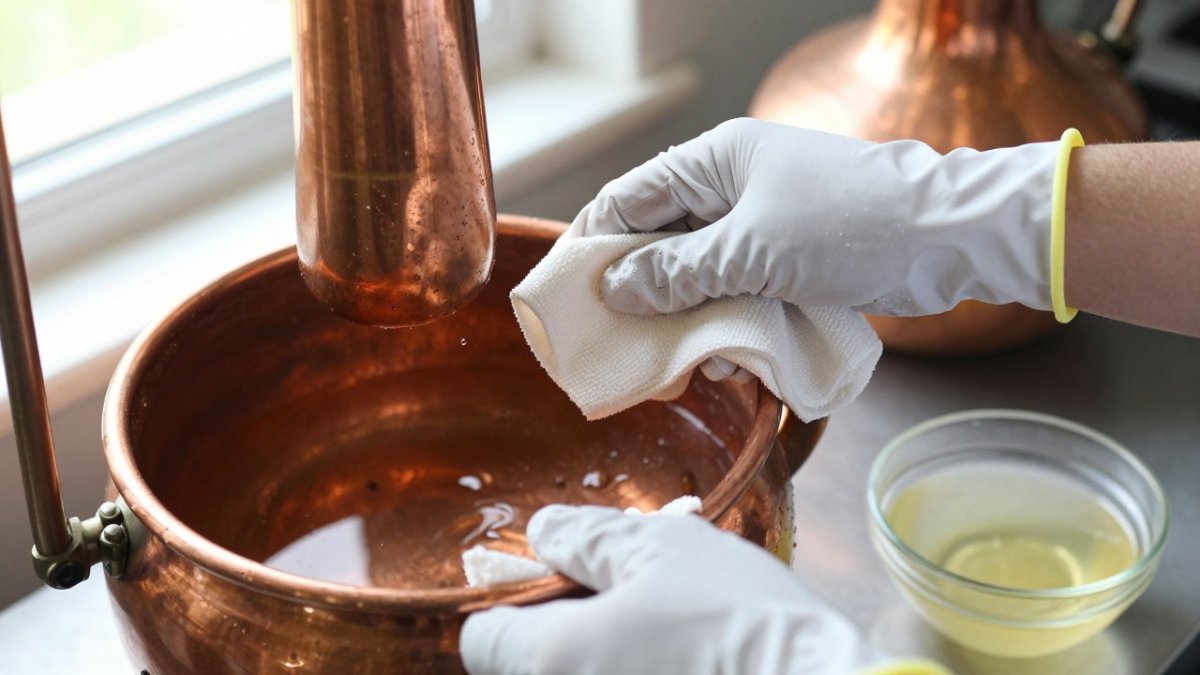
Here's the routine we recommend:
- Flush the still with warm water to loosen residue
- Apply a dilute citric acid solution to oxidized areas
- Rinse with distilled water until the runoff runs clear
- Dry the interior fully before storage
- Never leave acidic liquid sitting in the still overnight
For step-by-step cleaning guidance that avoids damage, read our full guide on how to clean a copper still.
A Spirits-Specific Diagnostic Workflow for Metallic Off-Flavors
Most guides stop at a list of causes. A diagnostic workflow is different: it isolates the source before you spend money on fixes, and it tells you when the problem is not the spirit at all. Run these steps in order and change only one variable at a time.
Step 1, Calibrate your palate. Metallic perception is easily skewed by what you ate or drank before. Rinse with distilled water, wait a few minutes, and taste a known-clean reference spirit of the same type at the same proof. If the reference also tastes metallic, the problem is likely your palate, glassware, or environment, not the bottle.
Step 2, Isolate the water. Proof a small sample down with distilled or reverse-osmosis water and compare it side by side with the same spirit proofed with your usual water. If the metallic note disappears with distilled water, your water chemistry is the source. This single test rules water in or out faster than any lab panel.
Step 3, Isolate the glass and closure. Pour the same spirit into two clean glasses: one glass you have just rinsed with distilled water, and one that has been sitting in its bottle with the original cap. Swirl, smell, then taste. Contamination from caps, synthetic corks, or reactive metal pourers often shows up here and nowhere else.
Step 4, Isolate the batch. If you are the producer, run a small batch with fresh ingredients and a freshly cleaned still. Compare it against the suspect batch under the same conditions. A metallic note that follows the ingredients points to raw materials; one that follows the equipment points to the distillation path.
Step 5, Isolate storage. Store a sample in a clean glass container with an inert closure for one week and taste it again alongside a sample kept in the original bottle. Flavor transfer from storage containers and closures is slow, so give it time.
Step 6, Rule out perception. If the metallic note survives every step, look at the taster. Dry mouth, oral health conditions, and some medications cause a metallic sensation that has nothing to do with the spirit. A simple check: have a second person taste the same sample blind.
Sample handling and escalation. If you suspect a commercial product, stop drinking it, keep the bottle and any remaining liquid, note the batch or lot code, and contact the producer before discarding anything.
When laboratory testing is warranted. Most home and small-batch cases resolve with the steps above. Lab testing for metal ions or water chemistry makes sense when the note persists across multiple batches, when you are scaling up and need documentation, or when a customer reports it.
Metallic Taste vs. Other Off-Flavors: Telling Them Apart
Metallic taste is often confused with other defects. Sensory evaluation separates them quickly.
- Metallic: tinny, sharp, blood-like, lingers on the palate
- Sulfur: rotten egg or matchstick, fades with air
- Acrid: harsh and bitter, from heads or tails cuts
- Moldy: musty and damp, from spoiled wash
Do a side-by-side sample comparison. Metallic notes stay put. Most others shift as the spirit breathes.
Ordering a Still Built to Keep Metallic Taint Out of Your Spirit
Equipment is the variable you can control completely. At Steven StillZ LLC, we hand-build every still from Paul Revere Copper using 20oz, 99.9% pure copper. Every unit gets 100% lead-free silver bearing solder, and parts are rolled, hemmed, and beaded for structural integrity.
Each still undergoes rigorous water and air pressure testing, so you get leak-free performance from day one. For current guarantee terms, check Steven StillZ LLC's website.
If metallic taste keeps coming back, the still may be the weak link. Browse our shop of hand-made copper stills to see what a properly built still looks like.
Stop guessing why your batches taste off. Get a still built from verified pure copper and lead-free solder, backed by our money-back guarantee. Get started with Steven StillZ LLC and distill with equipment that protects your spirit from the first run.
Frequently Asked Questions
Can copper equipment make spirits taste metallic?
Yes, but usually only when the copper is dirty, over-cleaned, or reacting with sulfur compounds and acids. A metallic taste in spirits from copper typically points to verdigris or oxidation inside the still, solder that is not lead-free, or a wash left sitting in the boiler. Clean the still, rinse with distilled water, and run a sacrificial batch before judging the equipment.
How can I tell whether a metallic taste comes from the still or the ingredients?
Run a controlled sample comparison. Distill a small batch of the same wash through a known-clean still and taste it against the suspect batch. If the metallic note disappears, the still or its cleaning routine is the source. If it stays, check your water, fermentation vessels, and raw materials. Taste the wash before distilling, too: a metallic note in the wash points upstream of the still.
When should a metallic taste in a spirit be considered a safety concern?
Treat it as a safety issue if the still uses unknown or non-lead-free solder, if you see green or blue corrosion inside the copper, or if the spirit was stored in a metal container not rated for high-proof alcohol. Lead and other metal contamination cannot be tasted reliably. Stop drinking the batch, do not sell it, and have the equipment inspected or replaced with lead-free, food-grade materials.
What causes a metallic taste in spirits besides the still?
Water is a frequent culprit: high iron, manganese, or zinc in tap or well water carries straight into the proofing jar. Storage in metal containers, caps with exposed metal liners, and ingredients like certain grains or additives can also contribute. Dehydration, medications, and other health factors can change your own taste perception, so confirm the off-flavor with a second taster before blaming the batch.