 how-to
Preventing Metallic Taste in Spirits: A Complete Guide
Table of Contents
- Preventing Metallic Taste in Spirits: The Basics
- How to Spot Poor Soldering on Distillation Equipment
- Cleaning Copper Stills for Flavor Neutrality
- Common Off-Notes in Distilled Spirits and What Causes Them
- Ion Leaching, Oxidation, and pH Balance in Acidic Spirits
- Chill Filtration and Dissolved Oxygen Control
- Sensory Testing Protocols and Water Quality Impact
- Conclusion: Protecting Your Liquor Profile
- Frequently Asked Questions
Last Updated: October 4, 2026
Preventing Metallic Taste in Spirits: The Basics
Preventing metallic taste in spirits starts with three things: clean copper, lead-free solder, and controlled acidity. A tinny, blood-like aftertaste almost always traces back to metal contact somewhere in your equipment, and it rarely comes from the recipe itself.
Below, we'll show you exactly how to find the source of a metallic taste and fix it before your next run.
Here's what most guides get wrong: they blame the mash. In practice, the still is usually the culprit.
Metallic taste is a sharp, tinny flavor that lingers on the back of the tongue. It signals that metal ions have entered your spirit.
Three common causes:
- Rust or exposed iron inside the boiler or column
- Acidic wash eating away at a reactive metal surface
- Solder joints leaking trace metals into the vapor path
Copper is the exception. It reacts with sulfur compounds and removes them, which is why the American Distilling Institute's guide to copper in distillation recommends copper in the vapor path for flavor cleanup. The problem starts when other metals enter the picture.
How to Spot Poor Soldering on Distillation Equipment
Poor soldering shows up as pinholes, gray crusty patches, or a rough seam that catches your fingernail. Any of these means vapor can escape or metal can leach into your spirit.
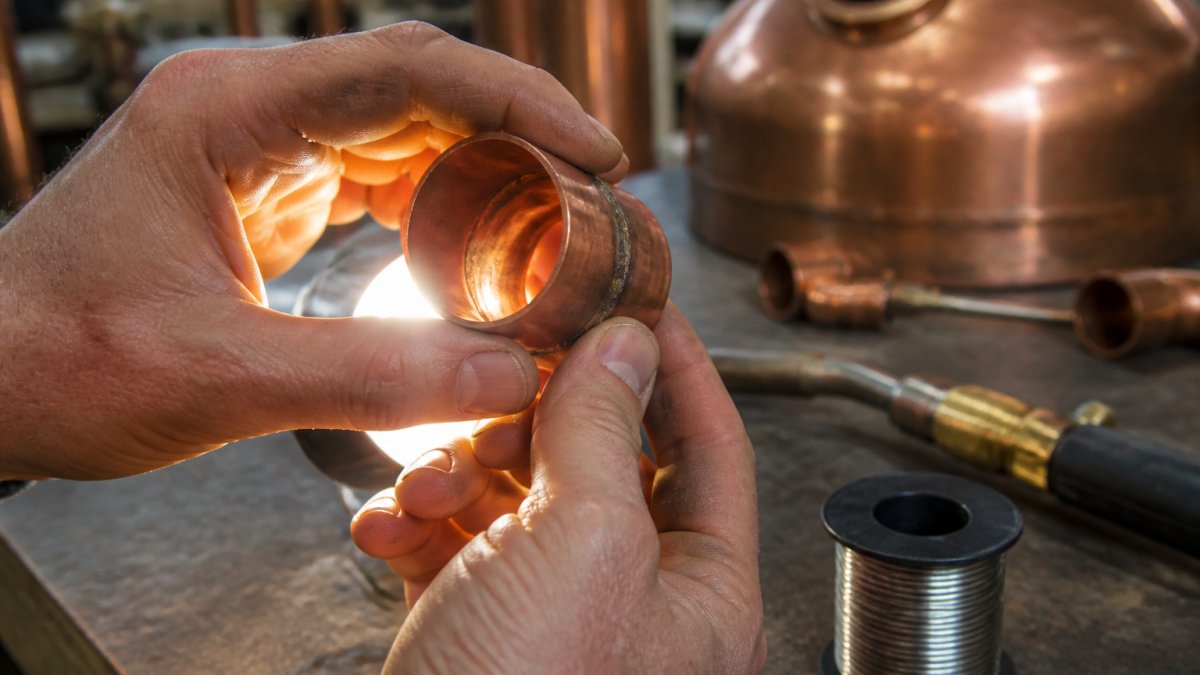
Check your still before every run:
- Look for white or green crust around joints
- Run a fingernail along each seam
- Shine a bright light behind the joint to spot pinholes
- Smell the joint after a cleaning run for a sour or metallic note
A common mistake is ignoring a slow drip during a water test. If water seeps out, vapor will too.
Cleaning Copper Stills for Flavor Neutrality
Cleaning copper stills for flavor neutrality means removing oxide and residue without scratching the metal. A soft cloth, warm water, and a mild acid rinse handle most jobs.
Steps that work:
- Rinse the still with warm water after every run
- Wipe the interior with a soft cloth
- Use a diluted citric acid solution for heavy tarnish
- Rinse again with clean water and dry fully
- Store with the lid off so air can circulate
What most guides miss is the drying step. Trapped moisture is what causes green spots to form between runs. Dry copper stays bright; wet copper turns.
Common Off-Notes in Distilled Spirits and What Causes Them
Common off-notes in distilled spirits fall into four groups: metallic, sulfur, cardboard, and solvent. Each points to a different part of your process.
| Off-Note | Likely Cause | Fix |
|---|---|---|
| Tinny, blood-like | Iron or copper salts | Check solder, replace reactive parts |
| Rotten egg | Sulfur compounds | Add copper in vapor path |
| Wet cardboard | Oxidation | Reduce dissolved oxygen, seal tight |
| Harsh solvent | Poor cuts | Tighten foreshots and tails cuts |
The metallic note is the one most distillers misread. It is not a recipe problem. It is a materials problem.
Ion Leaching, Oxidation, and pH Balance in Acidic Spirits
Ion leaching happens when an acidic wash pulls metal particles out of a reactive surface. The lower the pH, the faster this happens, and the more metal ends up in your distillate.
Here is the mechanism in plain terms. Acids donate hydrogen ions, which attack the oxide layer that normally protects a metal surface. Once that layer is breached, the underlying metal oxidizes and dissolves into the wash as positive ions. Those ions, iron (Fe²⁺/Fe³⁺), copper (Cu²⁺), zinc (Zn²⁺), and lead (Pb²⁺), are volatile enough to carry over in the vapor path. That is why a metallic note shows up in the bottle even when the wash itself tasted fine.
Passivation is the defense. Stainless steel relies on a naturally forming chromium-oxide layer that self-heals in the presence of oxygen. Copper forms a different protective layer, copper oxide and, in some cases, copper carbonate, which is why copper stays stable when clean but turns green or black when it sits wet. Scratches, abrasive cleaners, and chlorinated water all strip these layers and open a path for leaching.
Watch these factors:
- pH balance: Most wash and low-wine setups sit in the 3.5-5.0 range. The lower the number, the more aggressive the attack on reactive metals. A wash that drifts below roughly 3.5 will leach iron and zinc noticeably faster than one at 4.5.
- Dissolved oxygen: Oxygen drives oxidation of both the metal surface and the spirit itself. More oxygen means more oxide turnover, more ion release, and more stale, cardboard-like notes layered on top of the metallic one.
- Contact time and temperature: A wash sitting in a reactive vessel overnight at 90°F will pick up more ions than the same wash run through in an hour at 70°F.
- Trace minerals: Iron and copper salts taste sharp even at very low concentrations. A few parts per million of iron is enough to register as tinny or blood-like on the palate.
If your wash is unusually acidic, run it through copper and avoid any iron, galvanized, or unpassivated fittings. the FDA's guidance on food contact surfaces treats food grade titanium and properly passivated stainless as safe for beverage contact. Anything else is a risk.
Home-distilling angle most guides skip: If you are running a small copper pot still, the interior of the boiler and the inside of the column are the two surfaces that matter most. Inspect them for dull gray or greenish patches after every run. A quick passivation routine, warm water rinse, dilute citric acid wipe, thorough dry, restores the protective layer and cuts ion pickup on the next run.
Chill Filtration and Dissolved Oxygen Control
Chill filtration removes fatty compounds that cloud a spirit when cold. It does not remove metal ions, so it will not fix a metallic taste on its own.
How to chill filter:
- Chill the spirit to near-freezing
- Pass it through a fine filter
- Return it to room temperature slowly
- Bottle with minimal headspace
Dissolved oxygen is the bigger issue for long-term storage. Every time you open a tank, oxygen enters. Use inert gas blankets or fill tanks to the top. Seal bottles tight and store them cool and dark.
Sensory Testing Protocols and Water Quality Impact
Most guides stop at "taste it and see." That is not a protocol, it is a guess. Two content gaps the top-ranking articles miss are worth claiming here: a DIY sensory method that separates a true metallic note from harsh alcohol burn, and the role of dilution water in creating metallic perception before the spirit ever touches metal.
A DIY sensory protocol that actually distinguishes metallic from harsh
Metallic and harsh are easy to confuse after a long day of tasting. They live in different parts of the palate and behave differently as the sample warms.
A workable protocol:
- Use three tasters minimum. One palate is a data point; three is a signal.
- Taste blind, in identical glasses. Use the same glass shape, same pour volume (about 0.5 oz), same lighting.
- Serve at room temperature, not chilled. Cold masks metallic notes. A sample that tastes clean cold can turn tinny once it warms in the glass.
- Score for aroma, taste, and aftertaste separately. Metallic notes usually land on the back of the tongue and linger; harsh alcohol burn hits the front of the mouth and fades faster.
- Compare against a known-good reference. Keep a sealed reference bottle of the same product style and taste it alongside every batch.
- Log every result. Date, batch number, taster initials, and a one-line note on where the off-note appeared.
A simple trick to separate the two: dilute a small sample with an equal volume of odorless, metal-free water. Harsh alcohol burn softens noticeably; a true metallic note usually survives the dilution and can even become more obvious.
Water quality: the metal source most home distillers ignore
If your source water is high in iron or copper, you are adding metal before the wash even ferments, and again at proofing. Municipal water varies widely, and well water can carry iron at levels that taste fine in a glass of water but register as tinny in a spirit.
What to check:
- Iron and copper levels. the EPA's guidance on drinking water contaminants lists secondary maximum contaminant levels for iron (0.3 mg/L) and copper (1.3 mg/L action level). Those thresholds are set for drinking water aesthetics, not spirits, but they are a useful starting point. If your supply reads near or above them, treat it.
- Total dissolved solids. High TDS water can carry trace metals and minerals that concentrate during distillation and proofing.
- Chlorine and chloramine. These react with organics to form off-flavors that can read as harsh or chemical, and they accelerate corrosion on some metals.
If your water reads high, use filtered, reverse-osmosis, or distilled water for proofing and blending. Do not assume bottled "spring water" is low-mineral, check the label or test it.
Conclusion: Protecting Your Liquor Profile
That brings us back to the throughline: a metallic taste is almost never a recipe problem. It is a materials problem, and materials are fixable.
At Steven StillZ LLC, we build every still from Paul Revere Copper with 100% lead-free silver bearing solder, and each unit goes through rigorous water and air pressure testing before it ships. Our parts are rolled, hemmed, and beaded for structural integrity, so joints stay tight run after run. Every still carries a 100% money-back or replacement guarantee.
Order online 24/7 and protect your liquor profile from the first run.
Frequently Asked Questions
Why do my homemade spirits have a metallic aftertaste?
A metallic aftertaste usually comes from ion leaching, where acidic vapors or liquid contact reactive metals in your still. If you use lead-free silver solder and 99.9% pure copper, the risk drops. Check for green-blue corrosion inside the boiler or condenser. Also test your wash pH; highly acidic washes pull more metal into the distillate. Switching to high-quality copper components solves most cases.
Does copper equipment cause a metallic taste in alcohol?
Copper itself does not cause a metallic taste when it is clean and properly passivated. Problems start when copper is left dirty or exposed to acidic spirits for long periods. That leads to copper salts and a tinny or blood-like note. Regular cleaning and a passivation step keep copper flavor-neutral.
How do I clean my still to remove metallic flavors?
For heavy buildup, use a soft cloth and a mild acid solution on copper surfaces. Never use abrasive pads that scratch the metal, as scratches invite corrosion.
Can poor soldering cause metallic contamination in spirits?
Yes. Poor soldering creates porous seams where vapor escapes and where cleaning agents hide. If the solder contains lead, acidic spirits can leach it into the distillate. Even lead-free solder with a rough, incomplete joint traps residue that later shows up as off-notes. Inspect every joint for a smooth, shiny bead.