 How-to
How to Spot Signs of Poor Quality Copper Stills
Last Updated: November 1, 2026
Quick Summary
Signs of poor quality copper stills include thin walls that flex under thumb pressure, lumpy or pitted solder joints with visible gaps, leaded solder, and seams that leak vapor during a water-only run. Ask for the copper gauge in ounces and the solder spec in writing before you buy.
- Copper purity should be stated as a percentage and wall thickness in ounces, such as 20oz.
- A sound seam is smooth, even, and fully sealed, with no gaps or green corrosion.
- Lead-free silver bearing solder is the standard to look for on every unit.
- In a leak test, growing soap bubbles at a joint mean escaping vapor.
- Surface tarnish wipes away with a mild cleaner, but pitting and soft spots signal metal loss.
Table of Contents
- Why Copper Quality Decides What Comes Out of Your Still
- Copper Versus Stainless Steel: What the Metal Choice Actually Changes
- How to Verify Copper Purity and Wall Thickness Before You Buy
- Reading Copper Still Solder Joints and Seams for Red Flags
- Why Lead-Free Solder for Copper Stills Is Non-Negotiable
- Running a Copper Still Leak Test at Home
- Oxidation, Wear, and When to Repair or Replace
- Ordering a Copper Still You Can Inspect With Confidence
- Frequently Asked Questions
Why Copper Quality Decides What Comes Out of Your Still
The metal in your still is not a container. It is part of the process. Copper quality matters because what happens at the copper surface shapes what lands in your collection jar.
Here is the part most buyers miss. Copper quality is a chemical decision, not a cosmetic one. Thick, pure copper does the work.
Below, we walk through the exact signs of poor quality copper stills, from wall thickness to solder joints to leak tests.
Copper Versus Stainless Steel: What the Metal Choice Actually Changes
Copper and stainless steel are not interchangeable. Each changes how your still performs and what your spirit tastes like.
Copper conducts heat far better than stainless steel. That matters at the boiler and in the column. Even heat means a steadier boil and fewer hot spots that scorch wash.
Where Copper Earns Its Place in the Vapor Path
Copper does real work where vapor touches it. It binds sulfur compounds and keeps them out of the distillate. That is why so many stainless stills still use a copper lining or copper mesh in the column.
- Copper contact in the vapor path improves flavor
- Copper handles heat transfer with less fuss
When a Stainless Steel Still Is the Right Call
Stainless has its place. It costs less up front, resists dents, and needs less polishing. If you want a stainless steel still for neutral spirits and plan to add copper mesh, that is a fair choice. But you lose the full copper surface, and you trade heat management for convenience.
| Feature | Copper Still | Stainless Steel Still |
|---|---|---|
| Heat conductivity | High | Low |
| Sulfur removal | Built in | Needs copper mesh |
| Oxidation | Tarnishes, needs care | Resists rust |
| Service life | Long with upkeep | Long, less upkeep |
| Cost | Higher | Lower |
How to Verify Copper Purity and Wall Thickness Before You Buy
Ask for the spec sheet before you pay. Copper purity should be stated as a percentage, and wall thickness should be stated in ounces, not guessed from a photo.
A common mistake is trusting a shiny photo. Shine hides thin walls. Here is how to check the real thing.
- Ask for the copper gauge in ounces, such as 20oz
- Confirm the source, like Paul Revere copper
- Request the solder spec in writing
Thin walls dent, warp, and wear through faster. For a deeper look at how thickness changes performance, see our guide on the best copper thickness for stills. And if you want to run the tests yourself, our article on how to verify copper purity walks through seven checks you can do before you buy.
Reading Copper Still Solder Joints and Seams for Red Flags
Solder joints are where cheap stills fail first. A sound seam is smooth, even, and fully sealed. A bad one is lumpy, pitted, or shows gaps.
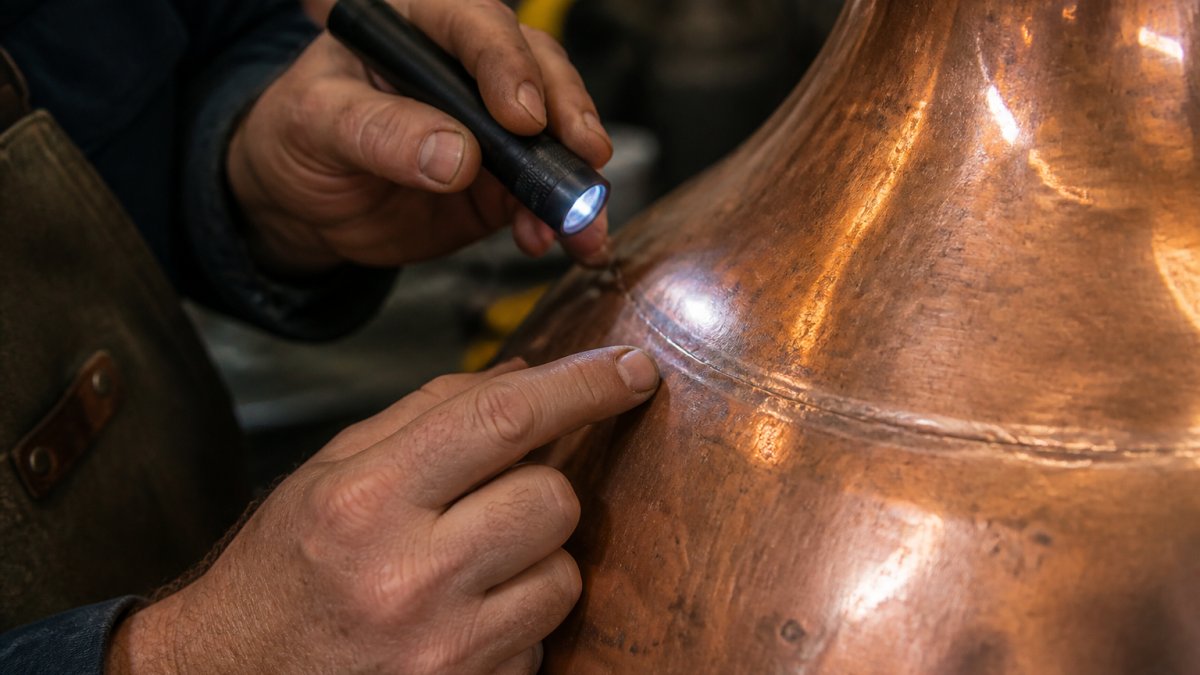
Run your eye along every seam. Then run a finger, gently. Here is what to watch for:
- Bumpy, uneven solder with visible gaps
- Dark or crusty patches at the joint
- Solder that looks like it was smeared on
Watch out: a pinhole gap at a seam can leak vapor during a run. That is a fire risk, not just a flavor problem.
Why Lead-Free Solder for Copper Stills Is Non-Negotiable
Lead has no place in a still. Lead-free solder for copper stills protects you from contamination that heat and vapor can carry into your spirit.
Old or cheap stills sometimes use leaded solder because it flows easier. That is a corner you cannot afford.
How do you confirm it? Ask for the solder spec in writing. To learn the checks, read our guide on how to identify lead-free solder.
Running a Copper Still Leak Test at Home
A leak test is simple, and it tells you more about a still's condition than any listing photo. A leak test checks whether vapor or liquid escapes at seams, fittings, or the condenser. Do it before every season, always before a first run on a new or used still, and any time you notice a new smell, drip, or wobble.
The Water-Only Run, Step by Step
- Fill the boiler with water only, no wash, no spirits. You are testing the vessel, not making product.
- Seal every fitting hand-tight. Do not over-torque; you can crack a solder joint or strip a fitting.
- Run a low, steady heat so the still reaches a gentle boil and produces vapor, not a violent roll.
- Watch each seam, fitting, and the condenser connection for mist, drips, or a hiss.
- Brush soapy water on suspect joints. Bubbles that grow mean escaping vapor.
- Shut down, let the still cool fully, then inspect the same spots again. Some cracks only open when the metal is hot.
Pass, Watch, or Stop: Grading What You Find
Most practitioners find that a leak test is only useful if you know what result means what. Use this three-tier read:
- Pass: No mist, no drips, no bubbles at any joint after a full heat-and-cool cycle. The still is cleared for the season.
- Watch: A single slow weep at a threaded fitting that stops when you snug it a quarter turn, or a faint soap bubble that pops and does not re-form. Re-test after the fix. If it returns, move to Stop.
- Stop: Any of the following means do not run the still until it is repaired or assessed:
- A pinhole or crack that lets vapor escape at a seam
- Solder that has pulled away from the copper, leaving a gap
- A fitting that wiggles or turns freely under hand pressure
- Green crust or dark pitting at a joint that weeps when hot
- A thin, soft spot you can flex with a thumb
A vapor leak is a fire and exposure risk, not just a flavor problem. Vapor escaping near a heat source can ignite, and vapor escaping anywhere else means you are losing product and breathing it. Treat any Stop finding as a hard stop until it is fixed.
The Air Pressure Check for Sealed Sections
For the condenser and any section you cannot easily watch during a run, a low-pressure air check finds pinholes that a water run misses. Cap one end, introduce gentle air pressure from a hand pump or your lungs, never a compressor, and brush soapy water along every joint. Our step-by-step guide on how to test a still for leaks covers each stage, including the air check and how to re-test after a repair.
Oxidation, Wear, and When to Repair or Replace
Copper tarnishes. That is normal, and it is not the same as corrosion. Oxidation is a surface layer that cleaning removes. Corrosion is metal loss that weakens the wall. The difference decides whether you clean and keep running, call a professional, or retire the still.
Grade the Damage Before You Decide
A common pattern is to lump every discoloration together. Grade it instead:
- Surface tarnish (acceptable): An even brown, bronze, or dark film across the copper. It wipes away with a mild cleaner and leaves sound metal underneath. Keep running.
- Localized green crust (inspect closely): Green deposits concentrated at a seam, fitting, or low spot. Clean it and look at the metal beneath. If the copper is bright and sound, the crust was surface residue. If the metal is pitted or dark, the joint is failing.
- Pitting and soft spots (concerning): Small pits, dark speckling, or areas that flex under thumb pressure. These signal metal loss. Stop and assess before the next run.
How to Check for Wall Thinning
Thin walls are the quiet failure. They dent easily, transfer heat unevenly, and wear through at seams and the boiler bottom where heat and wash concentrate. You cannot measure thickness from a photo, so check it in person:
- Press firmly with a thumb along the boiler wall and bottom. A wall that flexes easily is thinner than it should be.
- Compare the heft and rigidity of the boiler to the column and condenser. A boiler that feels noticeably flimsier than the rest of the still is a warning.
- Look for a bulge, a dent that springs back, or a ripple near a seam, all signs the wall has lost thickness.
If you are buying used, ask whether the still has been pressure-tested and when. A still with unknown history and a soft wall is a repair bill waiting to happen.
Repair, Professional Assessment, or Retire
Use this decision guide:
- Repair yourself: A slow weep at a threaded fitting, a loose connection you can snug, or surface tarnish. Clean, re-seat, and re-test.
- Professional assessment: A seam that weeps when hot, localized pitting at a joint, a small crack, or any doubt about wall thickness. A qualified metalworker or the maker can re-solder a seam or confirm whether the wall is sound. Repair is often cheaper than replacement, but only when the surrounding metal is still thick enough to hold the repair.
- Retire the still: A wall that flexes under thumb pressure, pitting that has thinned the boiler bottom, multiple failing seams, or a crack that keeps returning after repair. At that point the metal has lost the thickness that makes copper do its job, and no patch restores it.
A common cleaning mix is vinegar and bicarbonate of soda. Rinse well after. Skip harsh acids that eat the copper. Whatever you find, re-run the leak test after any repair before you trust the still with a batch.
Ordering a Copper Still You Can Inspect With Confidence
You cannot inspect what you cannot verify. That is the whole game with signs of poor quality copper stills: ask for the specs, read the seams, and test before you trust.
A still you can inspect with confidence comes with proof. Our stills are built from 20oz, 99.9% pure Paul Revere copper, with parts that are rolled, hemmed, and beaded, and 100% lead-free silver bearing solder.
Frequently Asked Questions
How can you tell if a copper still is good quality?
Start with the metal itself: a good still uses pure copper sheet with visible, even wall thickness, not a thin shell that flexes under finger pressure. Look at the seams and joints, which should be smooth, fully filled, and free of pinholes or lumpy excess solder. Ask what solder was used and confirm it is lead-free. Finally, ask whether the builder pressure-tests each unit. A still that passes a water and air pressure test before shipping is far less likely to leak on your first batch.
How do you verify the purity of copper in a still?
Ask the builder for the copper specification, including the mill source and the stated purity, and get it in writing. Reputable makers will name their supplier and quote a figure like 99.9% pure copper. You can also check the interior surface for uniform color and grain; patchy discoloration or a plated look can suggest a lower-grade or coated material. If a seller cannot tell you where the copper came from or how thick it is, treat that as a warning sign.
What should copper still seams and solder joints look like?
Seams should be rolled, hemmed, or beaded so the copper overlaps mechanically before any solder is applied. The solder itself should form a smooth, continuous fillet that fills the joint rather than sitting in lumps on top of it. Look for pinholes, cracks, gray or black crusty patches, and gaps where the two copper edges meet. Any joint that looks porous or has visible voids is a leak waiting to happen and a sign of rushed workmanship.
Can a copper still contain lead?
The copper itself does not contain lead, but the solder joining the seams can. Some low-cost builders use plumbing solder that contains lead, which is a real contamination risk because vapor and distillate contact those joints. Ask specifically for lead-free silver bearing solder and request confirmation in writing. If you already own a still of unknown origin, have the joints checked by a professional before running another batch through it.
Cheap copper shows up in the seams, the walls, and the solder, and it shows up in your distillate. If you are ready for a still built to be inspected, Steven StillZ LLC hand-builds every unit with pure copper, lead-free solder, and pressure testing on each one. Order online 24/7 and get a still that holds up to a close look.