 blog
Best Alternatives to Standard Copper Solder for Still Builders
Last Updated: November 5, 2026
Quick Summary
The best alternatives to standard copper solder are press fittings, compression fittings, and push-to-connect fittings, which create a mechanical seal instead of a metallurgical bond. For vapor-path seams, stay with lead-free silver bearing solder, since heat exposure rules out elastomer-based fittings.
- Press fittings need an expensive tool, and each fitting size often requires its own jaw set.
- Push-to-connect fittings rely on an O-ring that heat cycling and solvent exposure degrade over time.
- Compression joints can often be re-made with a new ferrule, while press fittings generally must be cut out.
- Buying a press tool rarely pays back for one or two stills; rent or stay with solder instead.
- Vapor path and column seams should use lead-free silver bearing solder for heat tolerance and a permanent seal.
Table of Contents
- Why Still Builders Look Beyond Standard Copper Solder
- How to Join Copper Pipe Without Soldering: The Main Methods
- No-Solder Copper Fittings: Pros, Cons, and Where They Fit
- ProPress vs Solder Longevity: Which Joint Lasts Longer
- What a ProPress Tool Costs and When It Pays Off
- Matching the Joining Method to Your Distillation Equipment
- Choosing the Right Joint for Your Next Copper Build
- Frequently Asked Questions
Why Still Builders Look Beyond Standard Copper Solder
The best alternatives to standard copper solder depend on what you're joining, how often you build, and whether an open flame is practical in your workspace. But we also know why builders ask the question.
Here's the tension most guides skip: copper solder is not one product. It's a category covering lead-free tin-silver alloys, leaded tin-lead alloys, and silver bearing variants with very different safety profiles. Builders who reject "standard solder" often reject only the leaded version, then buy a no-solder fitting that introduces its own weak point. That distinction matters before you spend anything.
Below, we break down each joining method, where it fits on a still, and what it costs you over time. If you're staying with solder and just want a better alloy, our guide on how to choose the right solder wire covers alloy selection in detail. Builders checking safety should start with how to identify lead-free solder and our breakdown of whether silver bearing solder is safe.
How to Join Copper Pipe Without Soldering: The Main Methods
Three torch-free methods dominate copper work: press fittings, compression fittings, and push-to-connect fittings. Each creates a mechanical seal rather than a metallurgical bond, which changes how the joint behaves under heat and vibration.
That's the core trade-off. A soldered joint becomes part of the pipe. A mechanical joint stays a separate component clamped around it.
Press Fittings and Press Connections
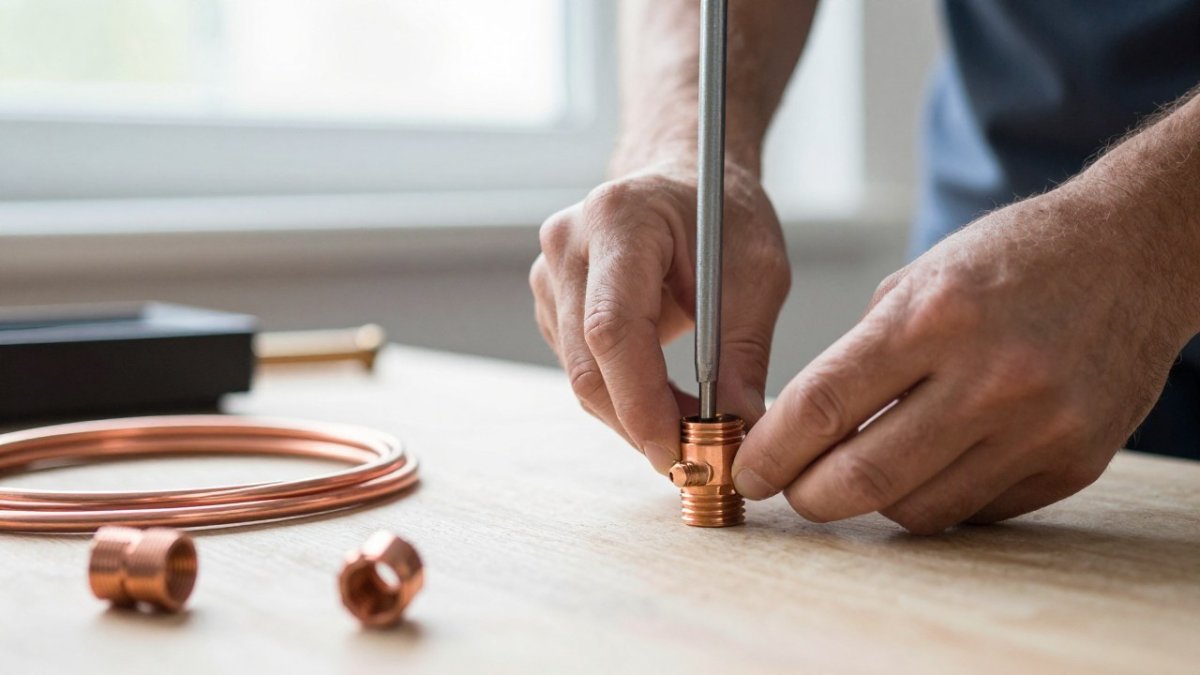
A press fitting slides over the copper tubing and a jawed tool compresses a ring around it, deforming the metal into a permanent seal. The connection takes seconds once the tool is charged. No flame, no flux, no hot-work permit.
The catch is the tool. Press tools are expensive, and each fitting size often needs its own jaw set.
Compression Fittings and Push-to-Connect Fittings
Compression fittings use a brass ferrule crushed against the pipe by a nut. Push-to-connect fittings use an internal grab ring and O-ring, sealing as you push the pipe home. Both are genuinely tool-light, which makes them popular in tight spaces and retrofits.
Neither is a permanent metallurgical bond. Both rely on an elastomer that ages.
No-Solder Copper Fittings: Pros, Cons, and Where They Fit
No-solder copper fittings win on speed and lose on service life. That's the honest summary, but it's not a complete one, because "no-solder" covers several distinct joining methods with different failure modes, different code standing, and different repairability. Treating them as one category is how builders end up with an O-ring in a vapor path.
Here is a method-by-method comparison:
- Press fittings: a jawed tool compresses a ring around the tubing to form a mechanical seal. Fast, no flame, widely accepted in commercial plumbing when installed with calibrated tooling and approved fitting-tool combinations. The wear points are the press ring and any internal seal. Removal requires a deburring or cutting step; the fitting is generally not reusable.
- Compression fittings: a brass ferrule is crushed against the pipe by a nut. Tool-light beyond two wrenches, easy to tighten and re-tighten, and easy to disassemble for repair. The ferrule deforms on first make-up, so re-making a joint often means a new ferrule. Common on water lines and appliance connections; less common on vapor paths.
- Push-to-connect fittings: an internal grab ring and O-ring seal as the pipe is pushed home. The fastest and most skill-tolerant option, and the easiest to remove and reuse. The O-ring is the life-limiting component, and heat cycling, solvent exposure, and UV degrade elastomers over time.
- Threaded adapters: a mechanical thread with pipe dope or thread tape. Robust and serviceable, but they require a threaded transition and are not a copper-to-copper joint. Common at equipment connections rather than mid-run.
- Approved adhesive and anaerobic systems: limited to specific product approvals and pipe materials; not a general substitute for a soldered copper joint. Verify the manufacturer's listing and local acceptance before relying on one.
Where each fits well:
- Temporary test assemblies and mock-ups: push-to-connect, for fast teardown.
- Tight spaces where a torch is a genuine fire hazard: press, or push-to-connect if the joint is accessible for later inspection.
- Retrofit work on an existing water line: compression or push-to-connect, because they can be made on a live-adjacent line with minimal clearance.
- Situations where shutting off and draining a system is impractical: push-to-connect, with the understanding that the O-ring is now a maintenance item.
Where they fall short:
- High-temperature zones near a boiler or burner: elastomer-based fittings are the wrong choice; heat exposure shortens seal life.
- Vibration-heavy setups: mechanical joints can loosen; threaded and compression joints need re-checking.
- Any joint you can't easily reach again to inspect: a silent leak in an inaccessible cavity is the worst outcome.
Watch out: push-to-connect fittings depend on an O-ring. Heat cycling and solvent exposure degrade elastomers over time, and a failed O-ring is a silent leak until it isn't. On a still, that's a safety issue, not a convenience one.
Before committing to any no-solder method, run a short code and certification checklist. Confirm the fitting is listed for potable water if it will carry drinking water, check its pressure and temperature ratings against your system's worst case, verify the manufacturer's installation requirements (insertion depth, deburring, tool calibration), and confirm local plumbing-code acceptance. Acceptance in commercial plumbing is not the same as acceptance for your application, and a product approval is specific to the product and the installation it was tested for.
Repairability is the other half of the story. A compression joint can often be re-made with a new ferrule; a push-to-connect fitting can usually be removed and replaced; a press fitting generally must be cut out and replaced. Plan access accordingly, and pressure-test every mechanical joint before you put it into service.
ProPress vs Solder Longevity: Which Joint Lasts Longer
Soldered joints have their own failure mode: poor workmanship. An underheated joint, a dirty pipe surface, or too little flux produces a joint that weeps. Knowing how to spot poor soldering is worth more than any spec sheet, because most solder failures are installation failures, not material failures.
What a ProPress Tool Costs and When It Pays Off
A press tool is a capital purchase, and the math only works at volume. The honest version of this section is a break-even calculation, not a slogan.
Start with the tool. Check current listings from tool suppliers and rental providers before deciding, because jaw compatibility is brand-specific.
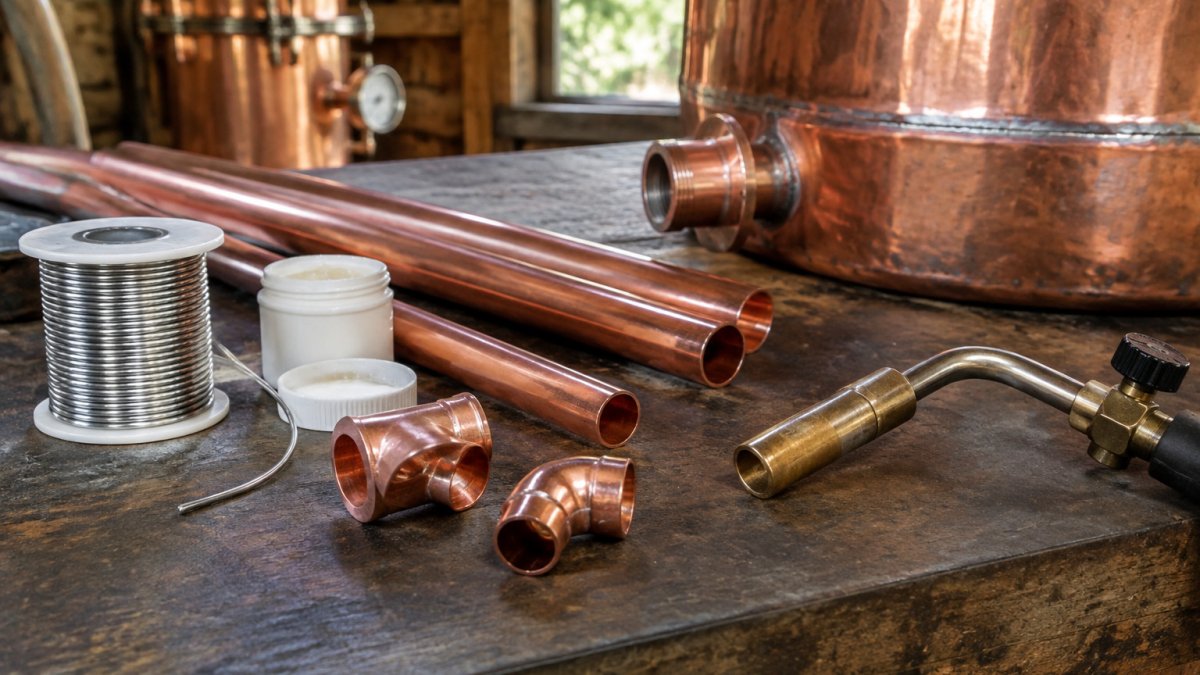
Then the fittings. A press fitting carries a per-unit premium over a comparable solder fitting and the loose components (wire solder, flux, and a torch setup you may already own). That premium is the recurring cost, and it scales with joint count, not with the tool.
Then labor. The savings from press work come from eliminating torch setup, flux cleanup, fire watch, and the hot-work permit process. If the person making the joint is paid, the labor delta per connection is what pays back the tool.
Run the decision this way:
- One or two stills, occasional repairs: rent a press tool for the session, borrow one, or stay with solder. Buying a tool and a full jaw set for a handful of joints rarely pays back.
- Regular builds, repeatable joints: a press tool starts to make sense once the saved labor per connection, multiplied by connections per month, exceeds the tool and jaw cost within a reasonable horizon. Track your own joint count before buying.
- Tight, flammable, or permit-restricted space: press wins regardless of cost, because the alternative is a hot-work permit, a fire watch, and the liability that comes with an open flame in an occupied building.
Watch out: jaw and fitting compatibility is not universal. A tool from one brand will not necessarily press another brand's fittings to the manufacturer's specification, and an out-of-spec press is a leak waiting to happen. Confirm the tool, jaw, and fitting are an approved combination before you rely on the connection.
For a shop, the ownership cost also includes calibration and jaw inspection over time. Press tools are mechanical and their jaws wear; a tool that no longer crimps to spec produces joints that pass a glance and fail a pressure test. Budget for that, and pressure-test press joints the same way you would a soldered seam.
Matching the Joining Method to Your Distillation Equipment
Not every joint on a still carries the same risk. Match the method to the location.
| Location on the Still | Best Joining Method | Why |
|---|---|---|
| Vapor path and column seams | Lead-free silver bearing solder | Heat tolerance, permanent seal |
| Pot-to-lyne arm connection | Soldered or press | Heat exposure rules out elastomers |
| Cooling water lines | Press or compression | Lower temperature, easier service |
| Temporary test rigs | Push-to-connect | Fast teardown, low stakes |
| Tight retrofit spaces | Press fitting | No flame, minimal clearance |
The vapor path is where shortcuts hurt most. That's the section carrying hot alcohol vapor, and it's the last place you want an aging O-ring.
Choosing the Right Joint for Your Next Copper Build
Pick the method by joint function, not by which tool you already own. Vapor-path seams should be soldered with a lead-free alloy. Water lines and test assemblies can take a mechanical fitting. Anything near the burner stays metal-to-metal.
If a seam does fail, don't improvise a patch mid-run. Our step-by-step guide to fixing leaking still seams walks through a proper repair.
We build with 99.9% pure copper and 100% lead-free silver bearing solder, and every unit is water and air pressure tested. If you'd rather start from a still that's already sealed right, browse our hand-made copper stills and order online 24/7.
Frequently Asked Questions
What can I use instead of standard copper solder?
The practical alternatives are press fittings, compression fittings, and push-to-connect fittings. Each creates a mechanical connection rather than a soldered joint. Press fittings need a specialized press tool, compression fittings tighten with wrenches, and push-to-connect fittings snap on with no tools. For distillation equipment, choose a method that keeps the vapor path all-copper and free of lead, and confirm the fitting is rated for the temperatures and pressures your still sees.
Is ProPress better than solder for copper pipe?
It depends on the job. Press connections go together in seconds with no torch, so there is no fire hazard and no hot-work permit, which matters in tight spaces and on retrofits. Soldered joints cost less in materials and have a long track record. For a still, the bigger question is whether the fitting's seals and materials suit hot alcohol vapor, so check ratings before you commit.
How do you join copper pipe without soldering?
Cut and deburr the pipe, clean the end, then use a mechanical fitting. Press fittings slide on and crimp with a press tool. Compression fittings use a nut and ferrule tightened with two wrenches. Push-to-connect fittings push on and lock with an internal grab ring. All three rely on pipe preparation and full insertion for a leak-free connection. Pressure-test every joint with water or air before the equipment goes into service.
Can adhesive join copper pipe for a pressurized system?
No. Adhesives and epoxies are not rated for pressurized potable water lines or hot vapor paths, and they can fail under heat cycling. Copper pipe connections in a plumbing system need a mechanical fitting or a soldered joint that meets code. For distillation equipment, skip adhesives entirely and use lead-free silver bearing solder or a rated mechanical fitting, then pressure-test the assembly before use.
The joining method you choose sets the ceiling on how long a build stays leak-free. Choose the alloy and the connection with the same care you'd give the copper itself. Get started with Steven StillZ LLC and build on copper, lead-free solder, and pressure-tested seams from day one.